
High Purity Chemicals for Labs: A 2026 Selection Guide
Table of Contents
- Why High Purity Chemicals for Labs Determine Experimental Success
- Decoding Purity Grades: Reagent Grade vs Technical Grade Chemicals
- ACS, USP, and HPLC Grades: Choosing the Right Standard for Your Method
- Certificate of Analysis Interpretation: Verifying Your High Purity Chemicals
- Laboratory Chemical Storage Best Practices for Purity and Stability
- Evaluating Suppliers: Compliance, Documentation, and Cost-Benefit Analysis
- Conclusion: Building a Reliable Sourcing Strategy for Your Lab
- Frequently Asked Questions
Last Updated: September 5, 2026
Why High Purity Chemicals for Labs Determine Experimental Success
The selection of high purity chemicals for labs is a direct determinant of experimental reproducibility and data integrity. Trace-level contaminants in a lower-grade solvent or reagent can generate spurious peaks, suppress ionization, or catalyze unintended side reactions, invalidating results. The cost of a failed run extends beyond the reagent price to include lost instrument time and compromised conclusions.
This guide breaks down the purity grade landscape, explains how to read a certificate of analysis, and provides a framework for building a sourcing strategy that protects your research.
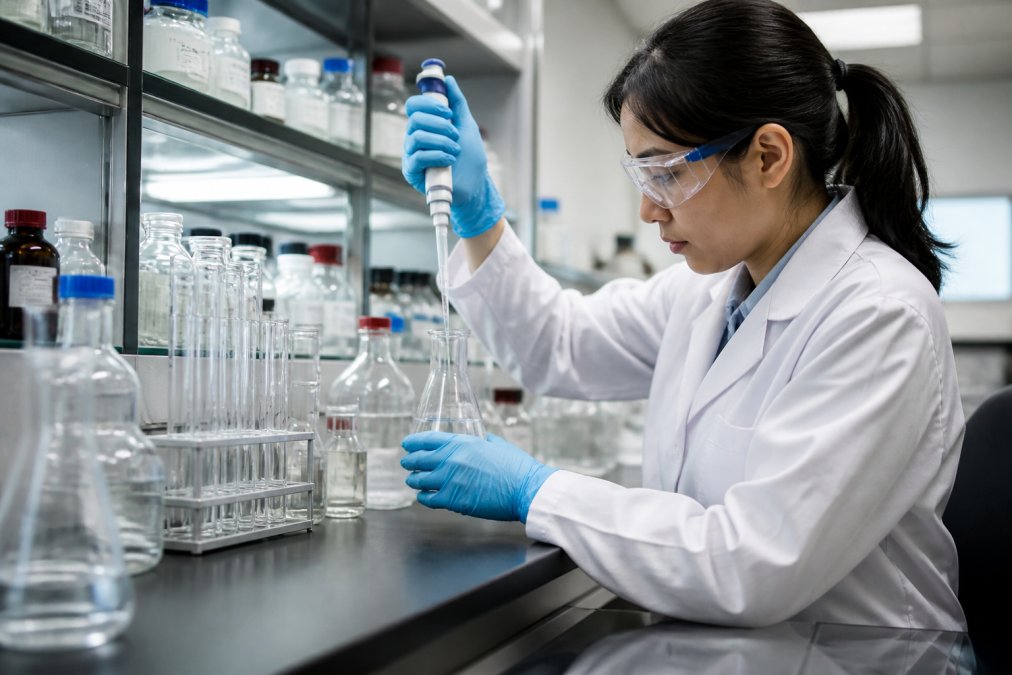
Not all “pure” chemicals are created equal. A reagent grade acid might suit a routine titration yet contain enough trace metals to ruin a spectroscopy experiment.
Decoding Purity Grades: Reagent Grade vs Technical Grade Chemicals
The most common procurement error is confusing reagent grade vs technical grade chemicals. Technical grade chemicals suit industrial applications where minor impurities do not affect the end product, making them unsuitable for precise quantification. Reagent grade chemicals meet purity standards set by organizations like the American Chemical Society for general laboratory use (acs.org).
Reagent grade is often the default choice for general lab work, but it is not a universal solution.
- Technical Grade: Suitable for cleaning, bulk synthesis, or educational demonstrations where trace impurities do not interfere. They lack a guaranteed impurity profile.
- Reagent Grade (ACS): Meets ACS standards for purity and is suitable for most qualitative and quantitative analyses where high purity is required.
- Analytical Grade: Often used interchangeably with reagent grade but may have tighter specifications for specific impurities like heavy metals.
Choosing technical grade for research is a gamble. Unknown contaminants can lead to irreproducible results, making it hard to diagnose whether a failure is due to your method or materials. For publication or regulatory submission, reagent grade or higher is the baseline.
ACS, USP, and HPLC Grades: Choosing the Right Standard for Your Method
Different analytical methods demand different purity thresholds. The grade you need is dictated by instrument sensitivity and analysis type, not habit or cost alone. The most common source of wasted budget is over-specifying purity; the most common source of failed runs is under-specifying it.
ACS Grade: The Workhorse for General and Preparative Chemistry
ACS grade chemicals meet the American Chemical Society’s Committee on Analytical Reagents standards, published in the Reagent Chemicals book, including limits on assay purity, residue on ignition, and heavy metals like lead, iron, and arsenic. For general lab work, buffer preparation, titrations, precipitation reactions, and most organic synthesis, ACS grade is appropriate and cost-effective.
The key advantage of ACS grade is that the impurity profile is defined, not assumed. A technical grade acid might be 95% pure with unknown contaminants; an ACS grade acid is typically ≥99.5% pure with documented maxima for routine analysis impurities.
When to use ACS grade:
- Preparing buffers and media where trace metals below 1 ppm do not affect the assay
- Running titrations where the endpoint is determined by a color change or pH probe
- Performing organic extractions and separations where the solvent is removed before analysis
- Cleaning glassware and preparing standard solutions for teaching labs
When ACS grade is insufficient: If your method involves trace metal analysis by ICP-MS, or if you are measuring UV absorbance below 220 nm where residual organic impurities create background signal, you need a higher grade. ACS grade is not designed for instrumental analysis at parts-per-billion detection limits.
USP Grade: When Regulatory Compliance Drives the Specification
USP grade chemicals meet United States Pharmacopeia-National Formulary (USP-NF) specifications, legally enforceable under the Federal Food, Drug, and Cosmetic Act for pharmaceutical ingredients (the FDA). For clinical and diagnostic labs, USP grade is often mandated by CLIA regulations or test kit manufacturer’s instructions.
The critical difference between USP and ACS grades is not always purity, both can be ≥99%, but which impurities are controlled and how the assay is performed. USP monographs specify the exact analytical method, so the CoA reports compendial method results. This matters for regulatory audits.
When to use USP grade:
- Preparing reagents for FDA-regulated clinical trials
- Running diagnostic assays where the test protocol specifies USP grade materials
- Compounding pharmaceuticals under USP <795> or <797> standards
- Any workflow that will be audited by a regulatory body that references USP monographs
For many general lab applications, USP and ACS grades are interchangeable in practice; the difference is regulatory, not chemical. If your lab does not face compendial compliance requirements, ACS grade may suffice at lower cost. If your quality manual references USP standards, do not substitute ACS grade without formal change control.
HPLC Grade: The Non-Negotiable Standard for Chromatography
HPLC grade solvents minimize UV absorbance, particulate matter, and non-volatile residue. The key specification is UV cut-off, the wavelength below which absorbance exceeds a defined threshold (typically 0.005 AU or lower). For acetonitrile, HPLC grade has a UV cut-off around 190 nm; reagent grade might exceed 210 nm due to UV-absorbing impurities.
Using a lower grade solvent in HPLC creates three problems: baseline noise and drift from UV-absorbing impurities, ghost peaks from impurities that co-elute with analytes, and column fouling from non-volatile residue. Each is time-consuming to diagnose and expensive to fix. The price difference between reagent and HPLC grade acetonitrile is typically 20-40% per liter, far less than one repeat run on a modern UHPLC system.
When to use HPLC grade:
- Any mobile phase preparation for HPLC, UHPLC, or LC-MS
- Sample preparation for GC-MS where solvent impurities create background ions
- UV-Vis spectroscopy below 250 nm
- Any method where you will report a limit of detection or quantification
When HPLC grade is overkill: If you are using the solvent for extraction followed by evaporation and reconstitution in a different solvent, the UV profile of the extraction solvent does not matter. In that case, reagent grade may be sufficient. Similarly, for normal-phase chromatography with UV detection above 280 nm, the stricter UV specifications of HPLC grade may not be necessary.
A Decision Framework for Grade Selection
Rather than defaulting to the highest grade available, use this three-question framework:
-
What is my detection method? If you are using UV detection below 250 nm, mass spectrometry, or fluorescence, you need the lowest UV-absorbing or lowest fluorescence-quenching grade available. If you are using refractive index or evaporative light scattering detection, solvent purity matters less.
-
What is my sample matrix? If your sample contains analytes at parts-per-million levels or higher, trace impurities in the solvent are unlikely to interfere. If you are quantifying analytes at parts-per-billion levels, every impurity in the solvent is a potential interference.
-
What does my method validation require? If you are running a validated method under GLP or GMP, you must use the grade specified in the validation protocol. If you are developing a new method, you have more flexibility, but you should document any grade changes in your development notes.
For labs that run both routine and trace-level analyses, maintain a dual inventory. Stock ACS grade for preparative and general work, and reserve HPLC or higher grades for instrumental analysis. This approach controls costs without compromising data quality.
The Cost-Benefit Reality Check
A common pattern in academic labs is purchasing the highest purity grade for everything to avoid contamination risk. This is wasteful. A 4-liter bottle of HPLC grade methanol might cost $120 versus $65 for ACS grade. If you use it for a simple extraction where the solvent is evaporated before analysis, you have spent $55 for no analytical benefit.
Conversely, using ACS grade solvents in a UHPLC-MS method is false economy. A single failed MS run costs more in instrument time and consumables than the entire price difference for a case of HPLC grade solvent. Total cost of ownership, not unit price, should drive purchasing decisions.
For labs that need to stretch budgets, consider these strategies:
- Buy the highest grade only for the solvents that contact your sample at the point of analysis (mobile phase, derivatization reagents)
- Use ACS grade for solvents that are removed before detection (extraction solvents, rinsing solvents)
- Consolidate orders to qualify for volume discounts without changing the grade specification
- Check the certificate of analysis for actual impurity levels, some ACS grade lots may have impurity profiles that meet HPLC specifications for your specific application, even if the label does not claim HPLC grade
Certificate of Analysis Interpretation: Verifying Your High Purity Chemicals
Certificate of analysis interpretation is a core competency for lab managers verifying that a shipment meets its stated specifications. A CoA is a manufacturer’s document reporting quality control testing results for a specific lot, the primary evidence that received chemicals match the label.
When you receive a CoA, do not just file it. Verify the following key elements:
- Lot Number: Confirm it matches the lot number printed on the product container.
- Assay Results: Check the purity percentage against the specification (e.g., ≥99.9%). Ensure the method used for the assay (e.g., GC, titration) is appropriate.
- Impurity Profile: Review the limits for specific impurities, such as residue on ignition or heavy metals. This is critical for trace metal analysis.
- Expiration Date and Storage Conditions: Confirm the material is within its valid period and that you can meet the storage requirements.
- Date of Analysis: Ensure the testing was performed recently enough to be relevant to the product’s shelf life.
A common mistake is accepting a CoA that does not list the specific impurities relevant to your application. If you are performing trace metal analysis, you need a CoA that guarantees low levels of metals. If the document only lists a general assay, it may not be sufficient for your quality assurance needs.
If a supplier cannot provide a CoA before purchase, treat this as a red flag. The absence of lot-specific documentation means you cannot verify purity, and your institutional quality assurance protocols may reject the shipment upon arrival.
Laboratory Chemical Storage Best Practices for Purity and Stability
Proper storage maintains chemical purity over time; improper conditions can degrade even the highest grade materials. Best practices prevent contamination, chemical degradation, and hazardous reactions. A reagent exposed to air, light, or moisture can absorb contaminants or decompose, altering its impurity profile and compromising future experiments.
The foundation of sound storage is segregation based on chemical compatibility. Acids, bases, oxidizers, and flammables must be stored separately to prevent dangerous reactions. Volatile organic compounds require ventilated cabinets. This segregation also prevents cross-contamination that can ruin sensitive reagents.
Consider these protocols for maintaining chemical stability:
- Temperature Control: Store chemicals according to the manufacturer’s specifications. Some reagents require refrigeration, while others must be kept at room temperature. Fluctuations can cause degradation.
- Container Integrity: Keep containers tightly sealed when not in use. Use dedicated spatulas to prevent introducing contaminants into the stock bottle.
- Light Protection: Store light-sensitive chemicals in amber glass or opaque cabinets to prevent photodegradation.
- Inventory Rotation: Label all containers with the date received and use the oldest stock first to ensure you are working within the shelf life.
- Safety Data Sheets: Maintain an accessible binder of Safety Data Sheets (SDS) for all chemicals, and review them for specific storage and handling requirements.
These practices reduce contamination risk and ensure materials perform as expected. The time invested is minimal compared to the cost of repeating a failed experiment or disposing of degraded chemicals.
Evaluating Suppliers: Compliance, Documentation, and Cost-Benefit Analysis
The choice of supplier is as critical as the choice of grade, as supply chain reliability directly impacts research consistency. Evaluate compliance posture, documentation practices, and pricing alignment. A supplier that cannot demonstrate rigorous quality assurance is a liability regardless of price.
Beyond price and delivery time, modern labs face two challenges most evaluation checklists ignore: supply chain transparency and troubleshooting contamination issues originating from the material itself.
Supply Chain Transparency: What to Ask Before You Buy
Supply chain transparency is becoming a requirement for labs satisfying institutional audit or federal regulations. The FDA’s Quality System Regulation (21 CFR 820) and Good Manufacturing Practices (21 CFR 210/211) require manufacturers to verify raw material suppliers (ecfr.gov). Even academic labs receiving NSF or NIH funding are increasingly asked to document reagent provenance in published methods.
When evaluating a supplier, ask these specific questions:
-
Where is the chemical manufactured? A supplier may be a distributor, not a manufacturer. If the chemical is sourced from a contract manufacturer overseas, you need to know whether that facility operates under current Good Manufacturing Practices (cGMP) and whether it has been inspected by the FDA or an equivalent regulatory body.
-
What is the chain of custody from manufacturing to your dock? Temperature-sensitive chemicals can degrade in transit. If a supplier cannot document the shipping conditions, you cannot be certain the material arrived in the same state it left the factory.
-
Does the supplier perform lot-specific testing or rely on the manufacturer’s CoA? Some distributors repackage bulk chemicals and issue their own CoA based on the original manufacturer’s data. This is acceptable only if the repackaging process does not introduce contamination. Ask whether repackaging occurs and under what conditions.
-
What is the supplier’s deviation and recall history? A reputable supplier will have a process for notifying customers when a lot is found to be out of specification. Ask how you would be notified if a problem is discovered after you have received the material.
-
Can the supplier provide a certificate of analysis before you place an order? This is the single most important question. If a supplier cannot or will not provide a CoA for the specific lot you are ordering, you cannot verify purity before purchase. Treat this as a red flag.
Troubleshooting: When Your Reagent Is the Problem
Even with a qualified supplier, contamination issues arise. The challenge is distinguishing between a method problem, an instrument problem, and a reagent problem. Here is a systematic approach to identify whether your high purity chemical is the source of experimental failure.
Step 1: Run a blank. If your method produces signals in a blank sample that contains no analyte, the contamination is coming from your reagents, your glassware, or your instrument. Run the blank with a fresh bottle of the highest purity solvent you have. If the blank is clean, the issue is your working solvent.
Step 2: Check the CoA against your application. If you are seeing ghost peaks in HPLC, look at the CoA for the solvent you used. Does it report UV absorbance at the wavelength you are using? Many CoAs report absorbance at 210 nm and 254 nm, but if you are detecting at 220 nm, you may be seeing impurities that the CoA does not address.
Step 3: Test a different lot. If the blank is dirty with your current lot, request a sample from a different lot number. If the problem persists across lots, the issue may be your storage conditions or your glassware cleaning protocol, not the supplier.
Step 4: Check for container contamination. High purity chemicals are often packaged in glass or specialized plastic containers. If the chemical is reactive with the container material, it can leach contaminants over time. This is particularly relevant for trace metal analysis, where borosilicate glass can contribute boron and other elements.
Step 5: Document everything. When you contact the supplier about a potential contamination issue, have your CoA, lot number, and experimental observations ready. A reputable supplier will want to investigate and may offer a replacement or credit. A supplier that is defensive or dismissive is a warning sign.
If you suspect a reagent is contaminated, do not simply discard it and move on. Document the issue, notify the supplier, and if the problem is significant, consider whether other labs using the same lot should be alerted. This is how the research community protects itself from systemic contamination events.
Cost-Benefit Analysis: When Reagent Grade Is Enough
The most common budget mistake is defaulting to the highest purity grade for every application. No one wants to ruin an experiment by saving $50 on a solvent, but wasting budget on grades that provide no analytical benefit is equally real.
Here is a practical framework for deciding when a lower grade is sufficient:
Reagent grade is sufficient when:
- You are performing a preparation step where the chemical is converted or consumed before the analytical measurement
- Your detection method is insensitive to the impurities that differentiate reagent grade from higher grades
- You are running a method that has been validated with reagent grade materials
- The impurity profile on the CoA shows that the actual lot meets your application requirements, even if the grade label does not claim it
Higher grades are required when:
- Your detection limit is near the impurity concentration in the lower grade
- Your method involves trace analysis where the impurity is the same element or compound you are measuring
- Your regulatory protocol specifies a particular grade
- You are developing a new method and need to eliminate variables
Maintain a grade justification log. For each chemical, document why you chose the grade. This helps defend purchasing decisions in an audit and prevents automatic upgrades without considering necessity.
The Total Cost of Ownership Calculation
When comparing supplier quotes, look beyond the unit price. Calculate the total cost of ownership using this formula:
Total Cost = (Unit Price × Quantity) + (Cost of Failed Runs × Failure Rate) + (Cost of Quality Assurance Time × Documentation Burden) + (Cost of Expedited Shipping × Lead Time Risk)
For example, if a cheaper supplier offers ACS grade methanol at $65 per 4L bottle but has a 5% rate of CoA discrepancies, and each discrepancy costs you 2 hours of QA time at $50 per hour, the true cost is $65 + (0.05 × $100) = $70 per bottle. A more expensive supplier at $75 per bottle with a 0.5% discrepancy rate has a true cost of $75 + (0.005 × $100) = $75.50. The difference narrows significantly.
For high-stakes experiments, the cost of a failed run is even higher. If an LC-MS run costs $200 in instrument time and consumables, and using a lower grade solvent creates a 2% risk of failure, the expected cost of that risk is $4 per run. If you run 100 samples per month, that is $400 per month in hidden risk, enough to justify paying a premium for a supplier with a better quality track record.
Building a Supplier Scorecard
To systematize supplier evaluation, create a scorecard that weights the following criteria:
| Criterion | Weight | What to Evaluate |
|---|---|---|
| Documentation Quality | 25% | CoA completeness, lot traceability, method references |
| Supply Chain Transparency | 20% | Manufacturing location, chain of custody, repackaging practices |
| Compliance Posture | 20% | cGMP certification, FDA registration, audit history |
| Technical Support | 15% | Responsiveness to contamination inquiries, willingness to investigate |
| Pricing and Lead Time | 20% | Unit price, volume discounts, delivery reliability |
A supplier that scores below 70% on this scorecard should be used only for non-critical applications. A supplier that scores above 85% is a strategic partner for your highest-stakes work.
The best supplier relationship is one where you can pick up the phone and discuss a CoA discrepancy without defensiveness. That level of transparency is worth more than a 10% price discount, because it protects you from the far greater cost of a failed experiment or a failed audit.
Conclusion: Building a Reliable Sourcing Strategy for Your Lab
Sourcing high purity chemicals requires a deliberate strategy balancing quality, compliance, and cost. The foundation is understanding your analytical methods’ purity requirements and verifying your supplier can meet them with proper documentation. Mastering grade selection, CoA interpretation, and storage protocols protects research integrity and laboratory efficiency.
At Viva Longevity LLC, we serve the research community by offering a curated selection of materials for qualified adults engaged in legitimate scientific work. We adhere strictly to federal, state, and local compliance requirements. Our commitment to safety and legal integrity, combined with a 30% discount on all orders, supports researchers in advancing their projects without compromising on standards.
Get started with Viva Longevity LLC by logging in to review our catalog and confirm your compliance requirements. Build a sourcing strategy that your lab can rely on for reproducible, publishable results.
Frequently Asked Questions
What defines high purity chemicals in a laboratory setting?
High purity chemicals have a tightly controlled impurity profile, verified through analytical testing. The acceptable level of contaminants depends on the grade, such as ACS, USP, or HPLC grade. For high purity chemicals for labs, manufacturers certify these low levels of trace metals, volatile organic compounds, and other impurities, ensuring they meet strict standards for sensitive applications like chromatography, spectroscopy, and material synthesis.
How do purity grades affect experimental reproducibility?
Purity grades directly impact experimental reproducibility. Impurities in lower-grade reagents can act as unexpected catalysts or inhibitors, leading to inconsistent results. Using a consistent, high purity grade, such as analytical grade, minimizes contamination risks and ensures that your experiments are repeatable. This is critical for precision laboratories and diagnostic accuracy where even trace contaminants can skew data and waste valuable research time.
What are the differences between reagent grade and technical grade chemicals?
The main difference between reagent grade and technical grade chemicals lies in their purity and intended use. Technical grade chemicals are suitable for industrial or educational purposes where high purity is not critical. In contrast, reagent grade chemicals are manufactured to meet high purity standards, like ACS standards, making them suitable for precise analytical work and laboratory reagents where contaminants can interfere with results.
How should high purity chemicals be stored to maintain integrity?
Proper storage is essential to maintain chemical stability and purity. Follow the safety data sheets (SDS) and manufacturer recommendations. General laboratory chemical storage best practices include keeping containers tightly sealed, protecting them from light and moisture, and storing them at the recommended temperature. Segregate incompatible chemicals to prevent dangerous reactions and contamination, ensuring the integrity of your high purity chemicals for labs.
