
How to Buy Specialized Chemicals for Research: A 2026 Guide
Table of Contents
- Why Supplier Choice Determines Research Validity
- Top Criteria for Choosing Where to Buy Specialized Chemicals
- Evaluating Research Chemical Purity Standards
- Navigating Specialized Chemical Documentation Requirements
- How to Verify Chemical Supplier Credentials Effectively
- Comparing Bulk Supply vs. In-Stock Inventory Options
- Matching Suppliers to Your Research Application
- Conclusion: Building a Compliant Sourcing Strategy
- Frequently Asked Questions
Last Updated: September 6, 2026
The integrity of your research project rests on where you buy specialized chemicals. A reagent with an incorrect purity certificate or a break in chain of custody can invalidate weeks of work and compromise published data. This guide from Viva Longevity LLC walks through the criteria that separate a reliable supplier from a liability.
Procurement now happens across digital catalogs, specialty distributors, and custom synthesis firms, each offering different grades and documentation levels. Below, we break down the verification steps, documentation requirements, and sourcing models that protect your research.
Why Supplier Choice Determines Research Validity
Supplier selection is a scientific control, not a purchasing formality. A supplier that cannot demonstrate lot traceability or provide a certificate of analysis introduces an uncontrolled variable into your experimental design.
When a supplier substitutes a lower grade or fails to disclose synthesis impurities, your results may reflect the contaminant rather than the compound under investigation. This is why institutions increasingly mandate approved vendor lists and documented purity analysis for every reagent.
Federal agencies and institutional review boards expect records tracing each chemical from receipt to disposal. A supplier with weak documentation creates a compliance gap that falls on your laboratory.
Top Criteria for Choosing Where to Buy Specialized Chemicals
When evaluating suppliers, start with a structured checklist rather than comparing catalog size alone. The following criteria consistently separate reliable vendors from problematic ones:
- Documentation completeness: Certificate of analysis, safety data sheet, and lot-specific purity data for every order
- Verifiable sourcing: Clear chain of custody from manufacturer to your laboratory
- Grade transparency: Explicit labeling of reagent grade, laboratory grade, or analytical standards
- Compliance posture: Demonstrated adherence to federal, state, and local regulations
- Technical support: Access to a chemical specialist who can answer questions about handling and compatibility
A common mistake is prioritizing price or delivery speed over these factors. The cost difference between a compliant supplier and a questionable one is small compared to repeating an experiment or addressing an audit finding. Suppliers offering a 30% discount on orders show that compliance-focused sourcing does not have to carry a premium.
Evaluating Research Chemical Purity Standards
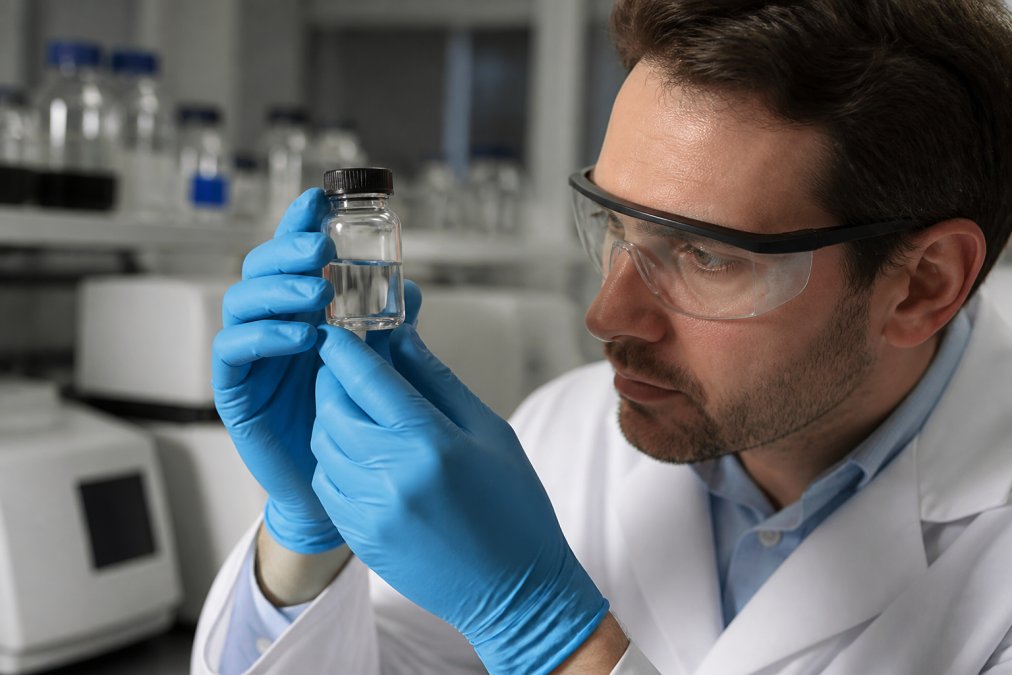
Purity grades are defined by specific tolerances for impurities and the analytical methods used to verify them. Misclassification is a leading cause of irreproducible results.
Decoding the Grade Designations
In the United States, you will most often encounter these designations:
- ACS Grade (American Chemical Society): The gold standard for analytical work, meeting or exceeding specifications in the Reagent Chemicals publication. For example, ACS-grade hydrochloric acid specifies a maximum of 0.5 ppm of arsenic and 1 ppm of heavy metals.
- Reagent Grade: High purity suitable for general laboratory use, though it may not have been tested against the full ACS specification sheet. Not a substitute for ACS grade when a method explicitly calls for it.
- USP Grade (United States Pharmacopeia): Intended for pharmaceutical manufacturing and compounding. Its impurity profile is not necessarily optimized for analytical chemistry and may contain excipients or stabilizers that interfere with sensitive assays.
- FCC Grade (Food Chemicals Codex): Designed for food products; meets safety standards for consumption but is not appropriate for rigorous laboratory analysis.
- Technical or Laboratory Grade: The lowest tier, suitable for educational demonstrations, bulk solvents for washing, or preparatory work. Using it in quantitative analysis will almost certainly introduce error.
The Certificate of Analysis: Your Primary Data Source
The certificate of analysis (COA) is the supplier’s contractual guarantee of purity, but only if you read it critically. A COA should be lot-specific, not a generic product sheet. Verify:
- Lot Number: This must match the lot number printed on the physical product label.
- Test Date: The analysis should be recent, typically within the last year for stable compounds.
- Purity Assay: Look for the specific method used (e.g., GC-FID, HPLC-UV, titration) and the resulting percentage. A purity of 99.9% is meaningless if the method is not sensitive enough to detect the specific impurity that could interfere with your reaction.
- Identity Confirmation: The COA should confirm the compound’s identity, often via techniques like FT-IR or NMR, not just the purity percentage.
- Impurity Profile: For critical applications, review the specific impurities listed. A COA that only states a purity percentage without listing tested impurities is a red flag.
Traceability to Recognized Reference Materials
For demanding applications such as environmental testing under EPA methods or clinical diagnostics, require standards traceable to the National Institute of Standards and Technology (NIST) or other recognized reference materials. This ensures your measurements align with a national or international benchmark for auditors and peer reviewers.
A Framework for Selection
To avoid ordering the wrong grade, use this decision tree:
- Is the work for a regulated quantitative analysis (e.g., EPA method, clinical assay)? Use ACS grade or a certified reference material (CRM) with documented traceability.
- Is the work for standard organic synthesis or qualitative analysis? Reagent grade is typically sufficient and more cost-effective.
- Is the work for method development or exploratory screening where cost is a primary concern? Consider laboratory grade, but be prepared to re-validate results with a higher grade if anomalies appear.
- Is the work for a teaching lab where precision is less critical? Laboratory or technical grade is appropriate.
By applying this framework, you move beyond simply buying a chemical to procuring a precisely defined material fit for its intended purpose.
When in doubt, request a sample of the COA before you place a bulk order. A reputable supplier will provide this without hesitation, allowing you to verify the analytical methods and impurity limits align with your requirements.
Navigating Specialized Chemical Documentation Requirements
Beyond the product itself, the documentation package is your primary defense against compliance findings, safety incidents, and data integrity challenges. For your lab, it should be a primary procurement criterion.
The Essential Documentation Package
Every order should arrive with a complete documentation package. Do not accept a shipment without it. The core components are:
- Safety Data Sheet (SDS): Governed by OSHA’s Hazard Communication Standard (29 CFR 1910.1200), the SDS is a 16-section document covering handling, storage, fire-fighting, accidental release, toxicological, and ecological information. Verify it is the current version and specific to the product received, not a generic document.
- Certificate of Analysis (COA): Your lot-specific proof of purity and identity. Not a regulatory requirement for all chemicals, but a de facto requirement for any research where data integrity matters.
- Chain of Custody (CoC) or Certificate of Origin: For controlled substances, select agents, or dual-use chemicals, a CoC traces the product’s path from manufacturer to lab, demonstrating it has not been diverted or tampered with. For imports, CBP entry paperwork is part of this chain.
Navigating U.S. Regulatory Frameworks
Your responsibility for compliance does not end at the purchase order. Be aware of the federal frameworks governing the chemicals you hold:
- OSHA Laboratory Standard (29 CFR 1910.1450): Requires laboratories to have a Chemical Hygiene Plan detailing safe handling, storage, and disposal. Your procurement records demonstrate compliance with this plan.
- EPA Regulations: Environmental testing methods are often governed by EPA protocols mandating specific purity grades and documentation. RCRA governs hazardous waste disposal, requiring accurate records of purchases and disposal.
- DEA Regulations: For scheduled chemicals, your lab must be DEA-registered and maintain meticulous records of acquisition, use, and disposal. A supplier not DEA-registered for these substances is not viable.
- Import/Export Considerations: International sourcing triggers EPA and CBP import requirements, such as a Notice of Arrival for pesticides or TSCA compliance. A U.S.-based supplier that has cleared these hurdles simplifies your compliance burden.
Building a Compliant Record-Keeping System
A common failure point is not the absence of documentation, but the inability to retrieve it when an auditor asks. Implement a simple, searchable system:
- Digital Archiving: Scan every SDS and COA into a shared, indexed folder immediately upon receipt, naming files with chemical name, lot number, and date.
- Cross-Referencing: Maintain a master inventory spreadsheet linking each chemical container to its corresponding COA and SDS file.
- Retention Policy: Retain all documentation for at least the project duration plus several years, or as long as data derived from the chemical is used in publications or grant reports.
Questions to Ask Your Supplier
Before committing to a purchase, ask the supplier these questions to gauge documentation readiness:
- “Can you provide a lot-specific COA for this product before I place the order?”
- “Is the SDS for this product compliant with the current OSHA HazCom 2012 format?”
- “For this specific compound, are there any U.S. state or federal registration requirements I should be aware of?”
- “Do you provide a Certificate of Origin for this product?”
A supplier that answers clearly demonstrates a compliance posture that protects your lab. A vague or defensive supplier transfers risk onto you. This documentation is the audit trail proving your research was conducted with integrity.
Failure to maintain proper SDS and COA records is a common finding in OSHA and EPA inspections. Penalties for non-compliance can range from thousands of dollars in fines to more severe actions, depending on the nature of the violation. The cost of a robust documentation system is negligible compared to the cost of a single citation.
How to Verify Chemical Supplier Credentials Effectively
Verifying supplier credentials requires active investigation rather than accepting website claims. Start by requesting references from other researchers in your field.
Check whether the supplier holds relevant registrations or certifications. Legitimate suppliers are transparent about their status and provide supporting documentation. A defensive supplier raises a red flag.
Review the supplier’s technical specifications against industry expectations. A supplier serving early-stage research should respond knowledgeably to questions about compound handling and stability.
The National Institutes of Health provides guidance on responsible chemical sourcing and research conduct emphasizes the importance of verifying supplier legitimacy before purchase. This is especially relevant when sourcing compounds that require careful handling or have restricted distribution.
Comparing Bulk Supply vs. In-Stock Inventory Options
The choice between bulk supply and in-stock inventory depends on your research phase. In-stock inventory suits early-stage research needing small quantities quickly. Bulk supply becomes relevant for scale-up manufacturing or consistent material across a long study.
| Sourcing Model | Best For | Key Advantage | Primary Tradeoff |
|---|---|---|---|
| In-Stock Inventory | Early-stage research, small orders | Fast delivery, minimal commitment | Higher per-unit cost, limited quantities |
| Bulk Supply | Scale-up manufacturing, large studies | Lower per-unit cost, consistent lot | Requires storage, larger upfront investment |
| Custom Synthesis | Novel compounds, specialized needs | Tailored to exact specifications | Longer lead times, higher cost |
Many researchers find a hybrid approach works best: use in-stock inventory for initial experiments, then transition to bulk supply once you have validated your protocol. This minimizes waste while ensuring adequate supply.
For academic labs with limited budgets, in-stock inventory with no minimum purchase requirements is often the practical choice. Confirm the supplier accommodates smaller orders without inflated pricing.
Matching Suppliers to Your Research Application
Different research applications demand different supplier capabilities. A drug discovery team needs diverse building blocks with rapid turnaround, while an environmental testing lab requires consistent, compliant materials. Understanding your needs prevents mismatched sourcing.
For drug development, prioritize suppliers with comprehensive catalogs and custom synthesis capabilities. Your research may require compounds not commercially available, making synthesis expertise as important as inventory.
For academic research, documentation and compliance often matter more than catalog breadth. Your institution’s legal team will scrutinize purchases, so choose a supplier that verifies the legality of your location and research type before selling.
The American Chemical Society publishes resources on chemical safety and laboratory best practices that can help you align supplier capabilities with your research requirements.
Conclusion: Building a Compliant Sourcing Strategy
A compliant sourcing strategy protects your research, institution, and career. It requires evaluating suppliers on documentation, purity standards, and regulatory adherence rather than price alone.
Viva Longevity LLC offers a curated selection of specialized chemicals for qualified adults engaged in legitimate research and educational work, with every transaction reviewed for compliance with federal, state, and local laws. Their regulatory adherence, combined with a 30% discount on all orders, provides access to essential materials for scientific and academic projects.
The Occupational Safety and Health Administration provides requirements for chemical hazard communication in laboratories underscores the importance of working with suppliers that prioritize safety and compliance.
For researchers who value audit trails, purity documentation, and a supplier that verifies the legality of your research context, Viva Longevity LLC provides reliable access to essential materials to advance your work with confidence. Login to Viva Longevity LLC.
Frequently Asked Questions
What criteria should be used to evaluate a research chemical supplier?
Evaluate suppliers on their documentation transparency, purity standards, and compliance record. Request a certificate of analysis for each batch and confirm they provide safety data sheets. Check for lot traceability and whether they follow regulatory compliance protocols. A reliable supplier will offer technical support from chemical specialists and clearly state their sourcing and quality assurance procedures.
What is the difference between analytical grade and research grade chemicals?
Analytical grade chemicals meet strict purity standards for precise laboratory analysis and are verified against recognized analytical standards. Research grade chemicals are suitable for early-stage research and exploratory studies but may have less rigorous purity documentation. Always confirm the grade meets your experimental requirements and that the supplier provides a certificate of analysis for the specific grade you purchase.
Are there specific documentation requirements for buying specialized research chemicals?
Yes. Expect a certificate of analysis, a safety data sheet, and clear lot traceability. Your institution may also require chain-of-custody documentation and proof of regulatory compliance. Established suppliers provide these documents proactively. If a supplier hesitates to share documentation, treat that as a warning sign and verify their credentials before proceeding.
How can researchers verify the purity and quality of specialized chemicals?
Request a certificate of analysis for the specific lot you are purchasing, not a generic document. Confirm the supplier uses recognized analytical methods and compare reported purity values against your requirements. Independent third-party testing adds confidence for critical experiments. Review the supplier’s quality assurance protocols.
