
How to Verify Chemical Purity: A Lab Guide
Table of Contents
- What You’ll Need to Verify Chemical Purity
- How to Read a Certificate of Analysis for Chemical Purity
- HPLC vs GC for Purity Testing: Choosing the Right Method
- Step-by-Step: How to Verify Chemical Purity in Your Lab
- Equipment and Reagents for Purity Verification
- Sourcing High Purity Chemicals for Labs: What to Look For
- Common Mistakes to Avoid When Verifying Chemical Purity
- Conclusion
- Frequently Asked Questions
Last Updated: September 13, 2026
What You’ll Need to Verify Chemical Purity
Verifying chemical purity starts before you open a single vial. It begins with documentation you can audit and ends with analytical data you can defend. This guide from Viva Longevity LLC walks through the full verification chain, from reading a supplier’s paperwork to running your own instrumental checks.
Chemical purity is the proportion of a sample that consists of the intended compound, with the remainder made up of impurities, residual solvents, and degradation products. A certificate of analysis (CoA) is your first line of evidence, but it is not proof on its own.
The equipment list is shorter than most people expect. A calibrated balance, reference standards, an HPLC or GC system, and a fume hood cover the majority of routine work. What separates a defensible result from a hopeful one is the paperwork trail behind it.
No single method confirms purity. Documentation, in-house testing, and third-party verification each catch different failure modes, and skipping any one leaves a blind spot.
How to Read a Certificate of Analysis for Chemical Purity
A certificate of analysis is a supplier-issued document reporting the test results for a specific batch. Reading one properly means checking that the batch number, test methods, and acceptance criteria all line up with what you ordered.
Key Sections of a CoA
Every credible CoA carries the same core blocks. When one is missing, ask why before you order.
| Section | What It Tells You | Why It Matters |
|---|---|---|
| Batch/Lot Number | Ties results to your shipment | Confirms the data matches your vial |
| Test Methods | How purity was measured | HPLC, GC, titration, or spectroscopy |
| Purity Result | Reported percentage | Compare against your spec |
| Impurity Profile | Named or grouped impurities | Reveals what else is present |
| Residual Solvents | Manufacturing carryover | Relevant for sensitive assays |
| Storage Conditions | Handling requirements | Prevents degradation in transit |
Red Flags in Supplier Documentation
The most common problem is a CoA that reports a purity figure without naming the method used to obtain it. A number without a method is not verifiable.
Other warning signs worth flagging to your procurement team:
- Batch numbers that do not match the label on the container
- Results that look identical across unrelated products
- No signature, date, or responsible analyst listed
- Impurity data omitted entirely rather than reported as below detection limits
- Storage instructions that contradict the product’s known stability
If a supplier cannot produce a batch-specific CoA on request, treat that as a stop signal. The FDA guidance on current good manufacturing practice outlines the documentation expectations that legitimate suppliers work within.
Accepting a generic “typical analysis” sheet instead of a batch-specific CoA is one of the most common mistakes in lab procurement. When an audit or publication review asks for traceability, a generic sheet will not hold up.
HPLC vs GC for Purity Testing: Choosing the Right Method
HPLC suits non-volatile and thermally labile compounds, while GC suits volatile and semi-volatile analytes. The choice hinges on your compound’s physical properties, not on which instrument is free that week.
High-performance liquid chromatography separates compounds in solution, making it the default for polar molecules, salts, and anything that would decompose under heat. Gas chromatography requires the sample to vaporize cleanly, which rules out most ionic species.
When to Use Each Method
| Method | Best For | Avoid When |
|---|---|---|
| HPLC | Polar, ionic, heat-sensitive compounds | Analyte lacks a usable chromophore and no detector fits |
| GC | Volatile, semi-volatile, thermally stable analytes | Compound degrades below its boiling point |
| HPLC-MS | Confirming identity alongside purity | Budget or throughput is tight |
| GC-MS | Volatile impurities and residual solvents | Sample is non-volatile |
For most research-grade reagents, HPLC with UV detection handles routine purity checks. When you also need structural confirmation, a mass spectrometer detector resolves both questions in one run.
Step-by-Step: How to Verify Chemical Purity in Your Lab
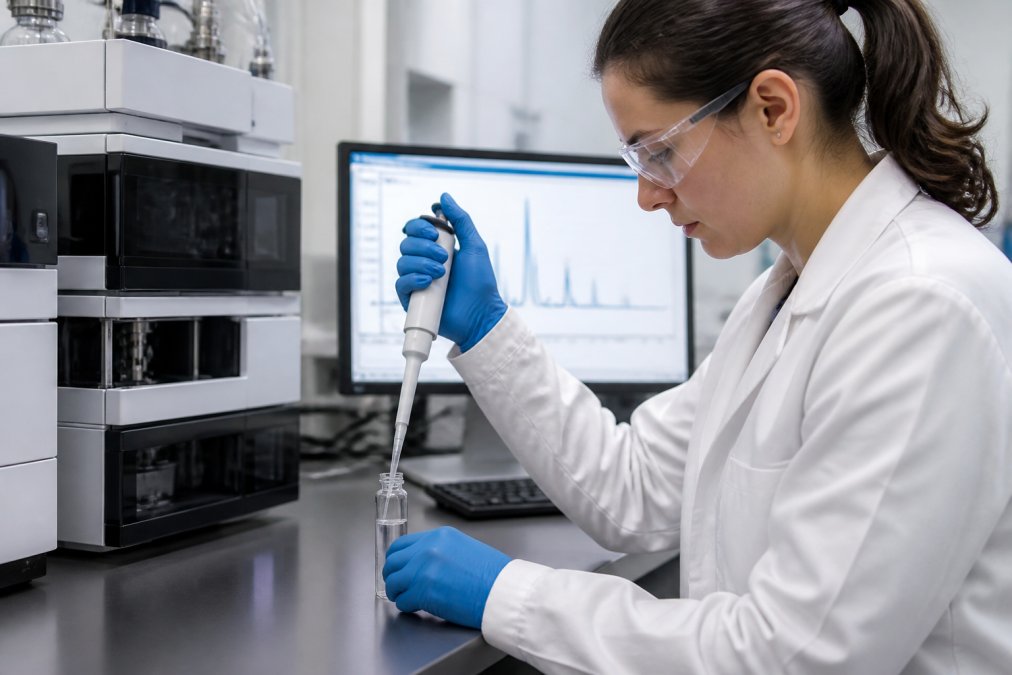
The verification workflow runs in three stages: documentation review, in-house testing, and independent confirmation. Each stage answers a different question, and the sequence matters.
Step 1: Review Supplier Documentation
Match the CoA batch number to the container label before anything else. Confirm the reported purity meets your specification, note the test method, and file the document against your internal lot record. This step takes minutes and prevents the most expensive errors.
Step 2: Perform In-House Testing
Run your own analysis on a representative sample. For HPLC, prepare a known-concentration solution, inject against a reference standard, and compare retention time and peak area. Document your instrument calibration date alongside the result. A purity figure without a calibration record is difficult to defend later.
Step 3: Send Samples for Third-Party Verification
Independent labs catch what in-house testing misses, particularly when your method has not been validated for a new compound. Reserve this step for critical batches, novel suppliers, or any material headed into regulated work. The NIST reference materials program maintains standard reference materials that help anchor your results to a traceable baseline.
Equipment and Reagents for Purity Verification
The core instrument set is an HPLC or GC system with an appropriate detector, a calibrated analytical balance, and volumetric glassware. Reagents include HPLC-grade solvents, reference standards, and sample filtration supplies.
What most guides miss is the consumables budget. Columns degrade, filters run out, and reference standards expire. A common mistake is underordering standards, which forces teams to stretch vials past their useful life and quietly undermines every result that follows.
Log every reference standard’s lot number and opening date on the vial itself. When a result looks off months later, that single notation tells you whether the standard or the sample is the problem.
Sourcing High Purity Chemicals for Labs: What to Look For
High purity chemicals for labs should come from suppliers who provide batch-specific documentation, clear storage guidance, and a responsive compliance team. Price matters, but traceability matters more when a result has to withstand review.
Questions worth asking any vendor before the first order:
- Can you supply a batch-specific CoA with named test methods?
- Do you verify that a purchase is legal for the buyer’s location and research type?
- What is your process for handling a documentation request after delivery?
- Are storage and handling instructions included with every shipment?
At Viva Longevity LLC, every product listing is restricted to qualified adults engaged in legitimate research and educational work, and orders are reviewed against federal, state, and local requirements before they ship. That compliance step is not decoration. It is the difference between a supplier your institution’s legal team clears and one that creates a paperwork problem three months later. The DEA controlled substance schedules are a useful reference point when a compound’s status is unclear.
Common Mistakes to Avoid When Verifying Chemical Purity
The most frequent error is trusting a single data point. A purity percentage from one method, on one day, from one lab, tells you less than most people assume.
Watch for these patterns:
- Treating a supplier’s CoA as independent verification when the supplier also ran the test
- Skipping calibration records, which makes results hard to defend in review
- Testing a non-representative sample, such as the top of a container that settled during transit
- Ignoring storage conditions, which can degrade a pure compound after it arrives
- Failing to document the verification chain, leaving no audit trail for the next person
A verification process is only as strong as its weakest record.
Conclusion
Getting purity verification right takes more than one good instrument reading. It takes documentation you can trace, methods matched to your compound, and a supplier whose compliance posture survives scrutiny. Viva Longevity LLC supports research teams with batch-level documentation and review against federal, state, and local requirements. Log in to Viva Longevity LLC to review current availability and start your next project with materials you can document.
Frequently Asked Questions
What are the most common analytical methods for testing chemical purity?
The most common methods are HPLC (High-Performance Liquid Chromatography) for non-volatile compounds and GC (Gas Chromatography) for volatile compounds. Other techniques include mass spectrometry, NMR, and titration. Each method detects different types of impurities. For example, HPLC separates components based on polarity, while GC works for compounds that can be vaporized. The choice depends on your sample’s properties and the level of detail you need.
How do you interpret a Certificate of Analysis for research chemicals?
Start by checking the lot number and test date to ensure the CoA matches your batch. Look for the purity percentage, assay value, and identification method (e.g., HPLC, GC). Verify that the testing laboratory is accredited or reputable. Pay attention to any impurity profiles and residual solvents. A valid CoA should include the method used, acceptance criteria, and a signature from a qualified analyst. If key details are missing, request clarification from the supplier.
What is the difference between purity and assay in chemical analysis?
Purity refers to the percentage of the desired compound in a sample, excluding impurities. Assay measures the amount of the compound present based on a specific analytical method, often expressed as a percentage of the labeled amount. For instance, a sample might have 98% purity but only 95% assay if the method detects only a specific form. Both values matter: purity tells you how clean the sample is, while assay tells you how much of the active compound is actually there.
Why is third-party testing important for chemical purity verification?
Third-party testing provides an unbiased assessment of a chemical’s purity, independent of the supplier’s own claims. It catches errors or misrepresentations that in-house testing might miss, especially if you lack specialized equipment. Accredited labs follow strict protocols and can detect trace impurities at low levels. For research reproducibility and regulatory compliance, third-party verification adds a layer of confidence. It also helps document due diligence for audits or publications.
