
7 Steps to Document Research Materials Properly
Last Updated: October 24, 2026
Quick Summary
To document research materials properly, create three linked records: a material record per item with supplier and lot details, a source log per supplier showing why it was chosen, and a decision log for judgment calls. Fill the material record the day items arrive, use consistent naming conventions, and organize files by research phase to ensure reproducibility and regulatory compliance.
- Define your research scope first to avoid documenting irrelevant materials and creating unnecessary noise.
- Record material details the day items arrive, including supplier name, product code, batch number, and storage conditions.
- Use a three-part template system: material records, source logs, and decision logs linked by ID rather than duplicated.
- Create a folder structure organized by research phase (Materials, Methods, Data, Analysis, Results) with version control.
- Export a dated PDF snapshot of your records at each project milestone to create an immutable audit trail.
Table of Contents
- Why Documenting Research Materials Matters
- Step 1: Define Your Research Topic and Scope
- Step 2: Conduct a Preliminary Search and Locate Research Materials
- Step 3: Evaluate Source Credibility and Relevance
- Creating a Research Materials Template for Consistent Recording
- Step 4: Organize Research Files, Folders, and Version Control
- Research Materials Examples and Documentation Workflows
- How to Write a Materials and Methods Section for Reproducibility
- Frequently Asked Questions
Why Documenting Research Materials Matters
Proper documentation of research materials is the foundation of reproducible, credible science, and organizing document research materials systematically ensures compliance and reproducibility.
At Viva Longevity LLC, we work with researchers who know sloppy documentation costs time and credibility. Regulators expect to see exactly what you used and why. How to Ensure Regulatory Compliance in Research Labs outlines the specific documentation standards required for institutional and federal compliance.
The core reason documentation matters is reproducibility. If another team can’t reproduce your results because they don’t know what materials you used, your findings lose weight.
NIH guidelines on research integrity and documentation emphasize that maintaining detailed records of materials and methods is a requirement for federally funded research.
Step 1: Define Your Research Topic and Scope
Start by being specific about what you’re researching and what materials fall within your scope. A vague topic leads to vague documentation.
Write down:
- Your research question in one or two sentences
- The specific materials you’ll use (chemicals, biological samples, equipment)
- The timeframe of your research
This step prevents you from documenting irrelevant materials later. If your research is on enzyme kinetics, you don’t need detailed records of every lab supply you touch, only the materials that directly affect your experiment.
Many researchers skip this step and regret it: they document everything, creating noise, then can’t find a critical detail when they need it.
Step 2: Conduct a Preliminary Search and Locate Research Materials
Once you know your scope, search for the materials you need. This includes both finding where to source them and understanding what options exist.
Start by checking:
- Your institution’s existing inventory
- Supplier catalogs and specifications
- Published protocols in your field
As you locate materials, record where you found them. Note the supplier name, product code, batch number, and the date you accessed this information.
Many teams source materials casually, then can’t remember which vendor or batch they used. Documenting during the search phase avoids this.
Step 3: Evaluate Source Credibility and Relevance
Not all suppliers are equal. Some provide high-purity materials with verified testing. Others cut corners.
When evaluating a source, check:
- Third-party certifications or purity testing
- Whether the supplier provides certificates of analysis
- How long the supplier has been in business
High Purity Chemicals for Labs: A 2026 Selection Guide walks through the criteria for evaluating research material sources and understanding quality standards for lab chemicals.
Document your evaluation: why you chose one supplier over another, and any material that failed your credibility check. This protects you if someone later questions your choices.
Creating a Research Materials Template for Consistent Recording
Most guides say “use a template” and stop there. The useful version is three linked records: a material record per item, a source log per supplier or repository, and a decision log for judgment calls. Together they answer what a reviewer, auditor, or collaborator will actually ask.
1. The material record (one per item)
Keep one row per material in a spreadsheet, or one short form per physical container. The fields below are the minimum that survive peer review and institutional review.
| Field | What to Record | Example Format |
|---|---|---|
| Material ID | Your internal identifier, unique and never reused | MAT-0142 |
| Material Name | Full chemical or product name, plus any synonym | Sodium chloride (NaCl) |
| Identifier | CAS number, RRID, catalog number, or accession | CAS 7647-14-5 |
| Supplier | Company name and location | Vendor name, city, state |
| Product Code | Catalog number and lot/batch number | Catalog #, lot # |
| Purity/Grade | Specification as stated on the label or CoA | 99.5% (ACS grade) |
| Quantity Received | Amount and unit | 500 g |
| Date Received | Date the material arrived | 2026-01-15 |
| Storage Conditions | Temperature, humidity, light, container | 20-25 °C, desiccated |
| Expiration/Stability | Shelf life and retest date | Retest by 2028-01-15 |
| Certification | Certificate of analysis, SDS reference, or CoA file name | CoA_MAT-0142.pdf |
| Purpose in Research | Which experiment or aim uses it | Aim 2, enzyme kinetics |
| Linked Records | Source log ID and decision log IDs | SRC-003, DEC-007 |
2. The source log (one per supplier or repository)
The source log captures why a supplier or repository was chosen, so you are not reconstructing that reasoning months later.
- Source ID (SRC-001, SRC-002 …)
- Source name and type (commercial supplier, institutional repository, archive, collaborator)
- What you obtained (materials, datasets, protocols)
3. The decision log (one entry per judgment call)
This is the record almost no one keeps, and it is the one that saves you during review. Log any choice that a reader could reasonably question: why you selected one grade over another, why you excluded a batch, why you changed a storage condition, why you substituted a material.
- Decision ID (DEC-001 …)
- Date
- Decision (one sentence)
Build the three records as tabs in a single spreadsheet workbook, then export a PDF snapshot at each project milestone. The snapshot becomes your immutable record; the live workbook stays editable.
Make the template work day to day
- Fill the material record the day the item arrives, before it goes into storage. Memory of lot numbers and receipt dates fades within hours.
- Never reuse a material ID, even if you reorder the same catalog number. A new lot is a new record.
- Link, don’t duplicate. The material record points to the source log and decision log by ID rather than repeating the same text in three places.
A template is only as good as its consistency: recording every material the same way lets you find information in seconds, hand the file to a collaborator without explanation, and show an auditor a clean trail from supplier to experiment.
Step 4: Organize Research Files, Folders, and Version Control
Create a folder structure that mirrors your research process, organizing document research materials by type and phase.
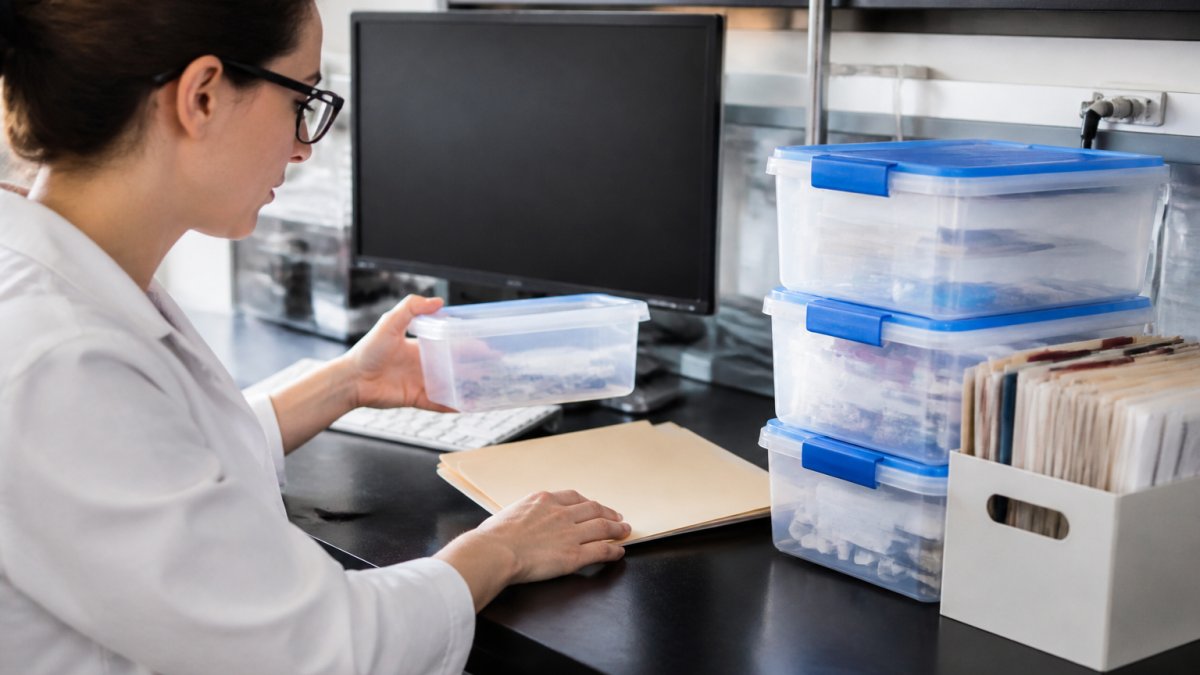
Use a naming convention for files and folders:
- Main folder: ProjectName_Year (e.g., EnzymeStudy_2026)
- Subfolders: Materials, Methods, Data, Analysis, Results
- Files: StartDate_Description_Version (e.g., 2026-01-15_MaterialsList_v1)
For version control, use simple numbering (v1, v2, v3): save updates as a new version instead of overwriting, creating a history you can reference.
Store everything in one place, a cloud service with version history (Google Drive, OneDrive) or a local repository, and back it up regularly.
Research Materials Examples and Documentation Workflows
Different material types need different metadata. A chemical record and an interview transcript share almost no fields, and forcing them into one template yields bloated or incomplete records. The table below gives the metadata each type requires, followed by a worked example.
| Material Type | Core Metadata to Record | Extra Cautions |
|---|---|---|
| Chemicals and reagents | Name, CAS number, grade/purity, supplier, lot/batch, receipt date, storage conditions, SDS/CoA file, container transfers | Record every container transfer; note any repackaging |
| Biological samples | Source organism or donor, collection date and method, storage temperature, processing steps, aliquot IDs, chain-of-custody log | Human-derived samples trigger consent and IRB documentation |
| Books and articles | Full citation, DOI or ISBN, edition, page range used, access date, PDF file name, notes location | Keep the exact edition and page numbers you relied on |
| Datasets | Title, creator, version, DOI or accession, license, download date, file checksum, variable dictionary, cleaning steps | Record every transformation; keep the raw file untouched |
| Interviews and surveys | Interview ID, date, duration, consent form reference, recording file name, transcript version, anonymization steps | Store consent separately from the transcript |
| Archival sources | Repository, collection name, box/folder/item number, date accessed, reproduction permissions, scan file names | Record call numbers exactly as the archive uses them |
| Images and figures | File name, capture date, instrument or camera, settings, scale, processing steps, original vs. edited version | Keep the unedited original; log every edit |
| Code and scripts | Repository URL, commit hash, language and version, dependencies, input files, run date, output files | Pin versions; a script without a commit hash is not reproducible |
| Equipment and instruments | Model, serial number, calibration date, maintenance history, settings used | Note any settings that differ from the default |
Worked example: a documented chemical record
A completed material record for a reagent might read:
MAT-0142, Sodium chloride (NaCl), CAS 7647-14-5, ACS grade 99.5%, Vendor name (city, state), catalog #S7653, lot #K49H1234, 500 g received 2026-01-15, stored 20-25 °C desiccated, retest by 2028-01-15, CoA_MAT-0142.pdf on file, used in Aim 2 enzyme kinetics, linked to SRC-003 and DEC-007.
That line answers who supplied it, the grade, the lot, how it was stored, and which experiment depended on it, traceable to the certificate of analysis in one step.
Worked example: a documented interview
INT-006, Semi-structured interview, 2026-02-03, 47 minutes, consent form CF-006 signed and stored separately, audio file INT-006_audio.m4a, transcript INT-006_transcript_v2.docx, participant identified only as P06, names and locations redacted, quotes cleared for use in Aim 3.
A simple workflow that scales
- Capture at the moment of use. Record the material or source while it is in front of you, not at the end of the week.
- Assign IDs immediately. A material without an ID tends to become a material without a record.
- Link records. Point each material to its source log entry and any decision log entries.
- Snapshot at milestones. Export a dated PDF or archive of the records at each project phase.
- Review before analysis. Before you start analyzing, confirm every material used has a complete record.
A common failure pattern is treating documentation as a final step. Records written from memory weeks later routinely miss lot numbers, storage changes, and substitutions, the exact details that make or break reproducibility.
Document as you go: write down what you did the same day, and let the material type dictate the fields. That habit, more than any template, separates a record that survives review from one that collapses under a single question.
How to Write a Materials and Methods Section for Reproducibility
When you write your final materials and methods section, draw directly from your documentation to ensure accuracy and completeness.
Your materials and methods section should answer these questions:
- What materials did you use? (names, suppliers, grades)
- Where did they come from? (batch numbers, dates)
- How did you prepare or handle them? (procedures, temperatures, timings)
Write in past tense and be specific.
How to Ensure Regulatory Compliance in Research Labs provides additional guidance on documentation standards required for institutional and federal compliance.
A methods section that references your documentation file beats one written from memory: you avoid errors and prove you kept proper records.
Proper documentation of research materials isn’t bureaucracy, it’s the backbone of credible science.
Frequently Asked Questions
What information should be included when documenting research materials?
Essential documentation includes the material name, source or supplier, purity level or grade, date acquired, lot or batch number, storage conditions, and any relevant certifications or compliance documentation. For research materials purchased from suppliers, record the product code and certificate of analysis. Include methodological notes on how the material was prepared or used in your research. This comprehensive record ensures reproducibility and meets institutional compliance requirements.
How can you make research documentation reproducible?
Reproducible research documentation requires standardized procedures, version control, and detailed metadata. Use consistent file naming conventions, maintain a README file that describes your project structure, and document all decisions affecting data collection and analysis. Record the exact specifications of research materials used, including lot numbers and dates. Create a data management plan that specifies how materials are stored, handled, and preserved. This systematic approach allows other researchers to replicate your work and validates your findings.
Is there a template for documenting research materials?
Yes, effective templates include fields for material identification (name, source, product code), acquisition details (date, supplier, cost), physical properties (purity, grade, concentration), storage requirements, usage log, and compliance certifications. Many research institutions provide discipline-specific templates aligned with their standards. A basic template should capture source evaluation notes, methodological decisions, and chain of custody information. Customizing a template to your research workflow ensures consistency across your project and simplifies handoffs to collaborators or future researchers.
How detailed should a materials and methods section be?
A materials and methods section should be detailed enough that another qualified researcher could replicate your work using only your documentation. Include specific material names, grades, and lot numbers; exact quantities and concentrations; equipment specifications; step-by-step procedures; and relevant environmental conditions. Document why you selected particular materials and any deviations from standard protocols. Provide sufficient detail on data collection and analysis procedures so that your methodology is transparent and your results are verifiable. Institutional guidelines and discipline-specific handbooks often specify the depth required for compliance.

