
Is High Purity Worth the Cost? Lab Reagent Value Guide
Table of Contents
- What High Purity Actually Means and Why It Costs More
- Analytical Grade vs Reagent Grade: Which One Does Your Work Need?
- How to Interpret a Certificate of Analysis Before You Buy
- The Impact of Impurities on Research Data and Reproducibility
- Cost-Benefit Analysis: When High Purity Pays for Itself
- Regulatory Compliance and Purity Standards to Verify
- Conclusion
- Frequently Asked Questions
Last Updated: September 11, 2026
What High Purity Actually Means and Why It Costs More
High purity means a reagent’s measured impurity profile is low enough and documented well enough that trace contaminants won’t distort your results. That documentation, not the label, is what you’re paying for. At Viva Longevity LLC, we work with researchers who source materials for analytical and experimental work, and the question we hear most often is whether is high purity worth the cost when a standard-grade material would pass a casual glance.
Here’s the short answer: it depends entirely on what your method can tolerate. A reagent at 99% purity and one at 99.99% can differ by orders of magnitude in the contaminants that actually interfere with a sensitive assay (peer-reviewed research). The price gap reflects the extra purification passes, the analytical testing, and the documentation trail required to prove what’s in the bottle.
What most buyers miss is that purity is a specification, not a feeling. Two suppliers can both print “high purity” on a label while delivering very different materials.
Purity Grades in Plain Terms
Purity grades describe how much non-target material remains after manufacturing and how rigorously that residue has been measured. The grade name tells you the intended use, not just a number.
- Technical grade: adequate for industrial or non-critical work; impurities are not tightly characterized.
- Reagent grade: meets general laboratory suitability standards; suitable for many routine procedures.
- Analytical grade: verified for analytical work, with tighter limits on interfering contaminants.
- High-purity / trace-grade: the lowest practical impurity levels, usually with method-specific testing.
The grade is a promise about fitness for a category of work. Whether that promise matters to you depends on your detection limits.
Analytical Grade vs Reagent Grade: Which One Does Your Work Need?
Analytical grade is the safer default when your results depend on accurate quantification; reagent grade is often sufficient when you need a reliable general-purpose material. The distinction matters most in trace analysis, where a contaminant at the parts-per-million level can shift a reading (peer-reviewed research).
A common mistake is buying analytical grade for everything “to be safe.” That inflates cost without improving outcomes for procedures that were never sensitive to those contaminants in the first place. The smarter approach is to match grade to method.
Ask three questions before you choose:
- What is my method’s detection limit for the analytes I care about?
- Which specific contaminants would interfere with that measurement?
- Does the grade’s documented impurity limits sit comfortably below those thresholds?
If a reagent grade clears all three, you don’t need to pay for more. If it doesn’t, analytical or trace-grade isn’t a luxury, it’s a requirement.
Pull the impurity specification for the exact contaminant your method is sensitive to, not the headline purity number. A 99.9% material can still fail your assay if the 0.1% happens to be the one element you’re measuring.
How to Interpret a Certificate of Analysis Before You Buy
A certificate of analysis (CoA) is the supplier’s documented record of what was tested, how it was tested, and what the results were for a specific lot. Reading it correctly is the single most useful skill in this entire purchase decision.
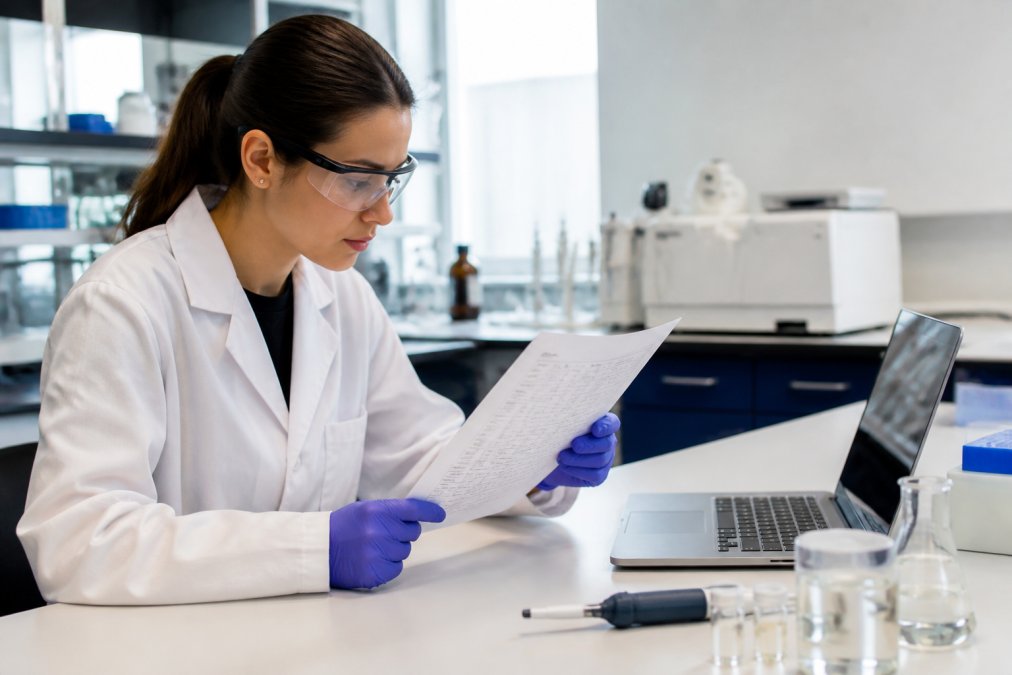
Start with the lot number and the test date. A CoA that isn’t tied to the specific batch you’re receiving tells you very little. Then check the analytical methods used. A purity figure backed by a validated method carries far more weight than one with no method named.
Look for these elements:
- Lot-specific identification matching the container you receive
- Named analytical methods for each reported value
- Impurity limits, not just a single purity percentage
- Traceability to the testing laboratory, whether in-house or third-party
If a supplier can’t or won’t provide a lot-specific CoA, treat the purity claim as unverified. That’s a documentation gap, and it’s the gap that most often trips up institutional procurement reviews.
The Impact of Impurities on Research Data and Reproducibility
Impurities undermine reproducibility because they introduce variables you didn’t account for and can’t see. When a result fails to replicate, the cause is sometimes the material, not the protocol.
Trace contaminants can catalyze side reactions, absorb or emit at your detection wavelength, or shift a calibration curve. The effect is often small per run, but it compounds across a study. This is why the impact of impurities on research data is a reproducibility problem first and a cost problem second.
The insidious part is that contamination doesn’t announce itself. Your instrument reports a number, and that number looks clean. You only discover the problem when a collaborator’s lab, using a different lot, gets a different answer.
Sourcing the same reagent from different lots without checking each CoA is a leading cause of “impossible” replication failures. If two lots differ in trace metals, your assay can drift even when your technique is identical.
Cost-Benefit Analysis: When High Purity Pays for Itself
High purity pays for itself when the cost of a failed experiment, a repeated run, or an invalidated result exceeds the price premium on the material. That’s the entire calculation, and it’s more concrete than it sounds, but only if you actually run it. Most buyers skip this step and default to either “cheapest available” or “most expensive available,” and both defaults waste money.
The Cost-Per-Valid-Result Framework
Instead of comparing sticker prices, compare cost per valid result. The formula is straightforward:
Cost per valid result = (Material cost + Labor cost + Instrument time + Sample cost) ÷ (Number of valid results produced)
A higher-grade reagent that costs more per bottle but produces a higher yield of valid results can win this calculation easily. A cheaper reagent that forces even one repeat run can lose it just as easily. The key is that the numerator includes everything consumed by a failed run, not just the reagent.
A Worked Example (Illustrative)
Suppose a single analytical run consumes:
- Reagent: a small fraction of a bottle, so the marginal reagent cost per run is modest
- Technician time: one to several hours of hands-on work
- Instrument time: the dominant cost in most labs, since a shared instrument has an opportunity cost equal to whatever else it could be running
- Sample: often the largest hidden cost, because irreplaceable or hard-to-obtain samples cannot simply be re-ordered
Now compare two scenarios across, say, twenty runs:
- Standard grade: lower bottle price, but a documented failure rate that forces, on average, one to two repeat runs per batch.
- High purity: higher bottle price, but a failure rate low enough that repeats are rare.
The high-purity option wins whenever the cost of those one to two repeats, instrument time plus labor plus sample loss, exceeds the price premium on the bottle. In most labs running sensitive methods, it does. In teaching labs running wide-tolerance demonstrations, it usually doesn’t.
Factors That Push the Decision Toward High Purity
- Irreplaceable or hard-to-obtain samples
- Methods with low detection limits (trace analysis, trace metals, trace organics)
- Studies where reproducibility is the deliverable
- Regulatory or publication requirements for documented materials
- Shared instruments where downtime has a real opportunity cost
Factors That Favor Standard Grades
- Teaching or demonstration work where precision isn’t the point
- Exploratory procedures with wide tolerance windows
- High-volume screening where per-unit cost dominates and a failed screen is cheap to repeat
- Methods whose detection limits sit well above the impurity levels in standard grade
The Break-Even Question to Ask
Before you buy, ask: How many failed runs would this material have to cause before the cheaper option becomes the more expensive one? If the answer is “one,” buy the higher grade. If the answer is “dozens,” and your method tolerates the impurity profile, the standard grade is the rational choice.
This is a cost-benefit analysis, not a purity contest. Buy the grade your science actually requires, and prove it with arithmetic, not instinct.
Track your repeat-run rate by lot for a quarter. Most labs discover that a small number of lots cause a disproportionate share of failures, and those lots are almost always the ones sourced without a lot-specific CoA.
Regulatory Compliance and Purity Standards to Verify
Compliance is about proving your materials meet the standards your institution and funders require, and that proof lives in documentation. For U.S. research laboratories, the relevant expectations typically come from your institution’s chemical hygiene plan, which operates under OSHA laboratory safety guidance, along with any funder or accreditation requirements specific to your work.
But “high purity” is not a single federal number. It is a claim that must be defined against a specific method, a specific contaminant list, and a specific detection limit. Understanding what those look like in practice is what separates a verified purchase from a marketing claim.
What “High Purity” Actually Means in Lab Testing
In practice, a high-purity claim is only meaningful when it is tied to:
- A named analytical method, for example, inductively coupled plasma mass spectrometry (ICP-MS) for trace metals, gas chromatography (GC) or GC-MS for volatile organics, or Karl Fischer titration for water content.
- A defined contaminant list, not a single headline percentage, but limits for the specific elements or compounds that interfere with your work (heavy metals, residual solvents, water, trace organics).
- A stated detection limit, the lowest concentration the method can reliably report. A purity figure without a detection limit is unverifiable.
- A lot-specific result, the number must belong to the batch you receive, not a representative sample from a year ago.
Contaminant Classes to Check on Every CoA
Most purity problems in research trace back to one of a handful of contaminant classes. Verify that your CoA reports limits for the ones relevant to your method:
- Trace metals, iron, copper, lead, arsenic, and others that can catalyze side reactions or interfere with spectroscopy.
- Residual solvents, leftover from manufacturing or purification; can shift chromatography baselines or add peaks.
- Water content, critical for moisture-sensitive reactions and for any gravimetric work.
- Trace organics, can absorb or emit at detection wavelengths and skew calibration curves.
- Particulates, can clog columns, foul instruments, or introduce nucleation sites.
Documentation That Clears Procurement Review
Institutional legal, safety, and procurement teams increasingly ask for three things before approving a purchase:
- Lot-specific CoA matching the container you receive
- Traceability to the testing laboratory, in-house or accredited third party, with the method named
- Chain of custody from manufacture to your bench
If any of those three is missing, the purity claim is unverified, and the purchase is a documentation risk regardless of what the label says.
Where to Verify
- Your institution’s chemical hygiene plan (the OSHA-aligned document governing lab chemical handling)
- Your funder’s materials and documentation requirements
- Any accreditation body relevant to your field
- The supplier’s own quality documentation, which should be available on request for any lot
The purity number is the easy part. The hard part, and the part that clears procurement review, is the documentation trail: a lot-specific CoA, a named analytical method, a stated detection limit, traceability, and verifiable chain of custody. Buy from suppliers who treat that trail as standard, not as a special request.
Conclusion
The real challenge isn’t deciding whether high purity is worth the cost in the abstract. It’s matching the grade to your method’s actual tolerance and confirming that the documentation holds up to institutional scrutiny. That’s where most sourcing headaches begin.
Viva Longevity LLC supports qualified researchers with materials intended for legitimate research and educational use, backed by a commitment to federal, state, and local compliance and a 30% discount on orders. Our focus is reliable access to the materials your work depends on, with the cautionary, documentation-first approach that serious labs require. Log in to review current availability and confirm what fits your project.
Frequently Asked Questions
What defines high purity in laboratory chemicals?
High purity means the trace contaminant level is low enough that impurities will not interfere with your specific analysis. It is defined by the certificate of analysis, which lists assay percentage and trace metals, residual solvents, or water content. Two bottles can both say 99% pure, yet one carries contaminants that shift a chromatogram baseline and the other does not. Purity is measured against your method’s detection limits, not a single universal number.
Are there risks associated with using lower-purity reagents?
Lower-purity reagents can introduce contaminants that skew results, cause failed runs, and waste time on repeat experiments. The impact of impurities on research data includes false peaks in chromatography, inaccurate calibration curves, and results that cannot be reproduced by another lab. For regulated work, non-compliant materials can also fail documentation review during institutional audit. The savings on the bottle often cost more in repeated experiments and lost instrument time.
How do you verify the purity of research materials before use?
Start with the certificate of analysis and check that the lot number matches your bottle, the assay meets your method’s threshold, and the testing lab is independent. Confirm the COA lists the specific contaminants relevant to your work, not just a generic purity figure. For critical experiments, run your own verification, such as a blank, a standard, or an orthogonal method, before committing samples. Keep the COA on file for audit and reproducibility records.
Does high purity always equate to better research outcomes?
No. High purity helps when contaminants interfere with your detection method, but it adds cost that may not change results for qualitative or teaching work. A reagent grade material can be entirely adequate for a solubility demonstration or a buffer prep where trace metals are irrelevant. Match the grade to the analytical question. Buying analytical grade for every task inflates budgets without improving data that never depended on trace-level cleanliness.
