
Which Research Chemicals Work Best for Academic Projects?
Last Updated: October 25, 2026
Quick Summary
Research chemicals academic projects are specialized compounds designed to support legitimate scientific inquiry, laboratory experimentation, and educational activities in universities and research institutions. Selecting the right chemicals requires understanding purity standards, institutional compliance requirements, and matching the grade to your project level.
- Research grade purity (95-98%) is sufficient for introductory and teaching labs focused on demonstrating procedures.
- High purity (98-99%) is recommended for undergraduate research and method development to avoid impurity peaks.
- Ultra-high purity (99%+) with batch-specific certificates of analysis is required for advanced research headed for publication.
- Always verify that the certificate of analysis batch number matches the label on your shipment before use.
- Request batch-specific documentation and check that purity was tested by appropriate methods like HPLC or mass spectrometry.
Table of Contents
- Understanding Research Chemicals for Academic Projects
- Chemical Categories and Laboratory Applications
- Evaluating Chemical Purity and Certificate of Analysis
- Chemical Safety Data Sheets for Researchers
- Laboratory Chemical Inventory Management
- Academic Laboratory Safety Checklist
- Compliance and Institutional Requirements
- Starting Your Research Chemical Procurement
- Frequently Asked Questions
Understanding Research Chemicals for Academic Projects
Research chemicals academic projects are specialized compounds and molecular substances designed to support legitimate scientific inquiry, laboratory experimentation, and educational activities in universities and research institutions. These materials form the foundation of hypothesis testing, drug discovery, and advanced chemistry education. Selecting the right research chemicals requires understanding purity standards, institutional compliance requirements, and the specific needs of your project.
At Viva Longevity LLC, we recognize that academic researchers face unique challenges when sourcing materials. You need suppliers who understand both the scientific rigor and regulatory complexity of your work. The difference between a reliable supplier and a problematic one often comes down to documentation, compliance verification, and transparency about material sourcing.
Chemical Categories and Laboratory Applications
Research chemicals fall into distinct categories, each serving different experimental purposes. Understanding these categories helps you identify the right materials for your specific project and ensures you’re purchasing compounds appropriate for your research scope.
Screening Compounds and Tool Molecules
Screening compounds are substances used to test biological hypotheses and evaluate how candidate molecules interact with specific biological targets. Tool molecules serve as reference standards or controls in experiments, allowing researchers to validate methodology and establish baseline measurements.
These compounds are critical for early-stage research because they help establish whether your experimental approach is sound before investing in more complex synthesis or testing. When evaluating screening compounds, verify that the supplier provides detailed characterization data, including purity analysis and stability information. Many academic labs use screening compounds to validate assay protocols before moving to custom synthesis.
Tool molecules differ from screening compounds in their application: they function as positive or negative controls rather than test subjects. This distinction matters for procurement because tool molecules often require higher purity standards and more rigorous documentation. Your institution’s compliance office may require certificates of analysis specifically for control compounds.
Molecular Building Blocks and Synthetic Compounds
Molecular building blocks are precursor compounds used in synthesis reactions to create larger, more complex molecules. Semi-synthetic compounds combine natural starting materials with chemical modification, while fully synthetic compounds are constructed entirely through chemical synthesis.
Building blocks enable chemists to design custom synthesis pathways without starting from raw elements. This approach accelerates research timelines and reduces waste compared to total synthesis. When sourcing building blocks, pay attention to the supplier’s synthesis methodology and purity specifications, as these directly affect your synthesis yield and final product quality.
Synthetic compounds represent the most complex category. These are often custom-synthesized for specific research applications and require the most detailed procurement documentation. Academic labs typically work with suppliers who can provide detailed synthesis routes, stability data under various storage conditions, and batch-specific certificates of analysis.
Evaluating Chemical Purity and Certificate of Analysis
The purity of your research chemical directly determines the reliability of your experimental results. A compound that appears to be 95% pure might contain contaminants that interfere with your assay, invalidating months of work. This is why certificate of analysis documentation is non-negotiable for academic research.
A certificate of analysis (CoA) is a document provided by the chemical supplier that documents the tested purity and composition of a specific batch. It typically includes high-performance liquid chromatography (HPLC) data, mass spectrometry results, and identity confirmation. Different research applications require different purity thresholds: analytical chemistry might require 99.5% purity, while some biochemistry applications accept 98% with documented impurity profiles.
Matching grade to project level and learning objective
One of the most common procurement mistakes in academic labs is over-buying purity. Ultra-high-purity reagent is expensive, often shipped in small quantities, and frequently unnecessary for a teaching lab whose learning objective is technique rather than trace analysis. Use the project level to set the grade:
- Introductory and teaching labs: Research grade (roughly 95-98%) is usually sufficient when the experiment demonstrates a principle, titration, recrystallization, a colorimetric assay. The learning objective is the procedure, not the detection limit.
- Undergraduate research and method development: High purity (roughly 98-99%) is the common choice when students are building or validating an assay, because impurity peaks can be mistaken for signal.
- Advanced research, analytical method validation, and anything headed for publication: Ultra-high purity (99%+) with a batch-specific CoA and full characterization is the defensible choice, especially where a reviewer may ask how the standard was qualified.
A useful rule of thumb: choose the lowest grade that still lets you distinguish your signal from your blank. If you cannot state why a higher grade changes your result, you probably do not need it.
Reading the CoA like a reviewer
When reviewing a CoA, look for these critical elements:
- Batch number and synthesis date
- Specific purity percentage and testing method used
- Identity confirmation (molecular weight, melting point, or spectroscopic data)
- Storage conditions and stability information
- Signature and credentials of the testing laboratory
Go one step further and read the test data, not just the headline number. A purity figure reported by HPLC area percent is not the same as a figure confirmed by an orthogonal method such as mass spectrometry or NMR. If the CoA lists only one method, ask whether a second confirmation exists for the batch. Also check the reported impurity profile: a 98% material with a documented, inert impurity is often safer for an assay than a 99% material whose remaining 1% is unidentified.
Some suppliers provide generic CoAs that don’t match the actual batch you receive. Request batch-specific documentation and verify that the batch number on your shipment matches the CoA you reviewed before purchase. If the numbers do not match, quarantine the material and contact the supplier before use.
Documentation checklist before you accept a shipment
- CoA batch number matches the label on the container
- Purity method is stated (HPLC, GC, titration, etc.) and is appropriate to the compound
- Identity is confirmed by at least one structural method
- Impurity profile is described, not just a percentage
- Storage and stability guidance is included
- SDS is on file and matches the compound and grade
Requesting high purity chemicals for labs: a 2026 selection guide will help you understand how to compare purity grades across different suppliers and applications.
| Purity Grade | Typical Application | Documentation Required | Acceptable Impurities |
|---|---|---|---|
| Research Grade (95-98%) | Educational labs, initial screening | Basic CoA with HPLC | Known, documented contaminants |
| High Purity (98-99%) | Drug development, analytical chemistry | Detailed CoA with multiple methods | Trace elements only |
| Ultra-High Purity (99%+) | Pharmaceutical synthesis, clinical research | Batch-specific CoA with full characterization | Minimal, often <0.1% |
Chemical Safety Data Sheets for Researchers
A Safety Data Sheet (SDS) is a standardized document that communicates hazard information about a chemical substance. In the United States, the Occupational Safety and Health Administration (OSHA) requires that every hazardous chemical distributed for use in the workplace include an SDS. For academic research, this means your institution must have an SDS on file for every chemical in your laboratory.
The SDS contains 16 standardized sections covering physical and chemical properties, hazard classification, first aid measures, storage requirements, and disposal guidance. Section 2 (Hazard Identification) and Section 5 (Fire-Fighting Measures) are particularly critical for laboratory safety planning.
Many academic researchers overlook SDS review until they encounter a problem. The time to read an SDS is before you receive the chemical, not after an accident. Identify potential hazards, confirm your laboratory has appropriate containment equipment, and verify that your waste disposal procedures align with the chemical’s disposal requirements.
Requesting how to ensure regulatory compliance in research labs provides detailed guidance on integrating SDS requirements into your institutional compliance framework.
Laboratory Chemical Inventory Management
Maintaining an accurate chemical inventory is both a compliance requirement and a practical necessity. Your institution likely requires documented tracking of all hazardous chemicals, including purchase dates, quantities, locations, and disposal records. This documentation protects your lab in audits and helps prevent accidental duplicate ordering or unsafe storage conditions.
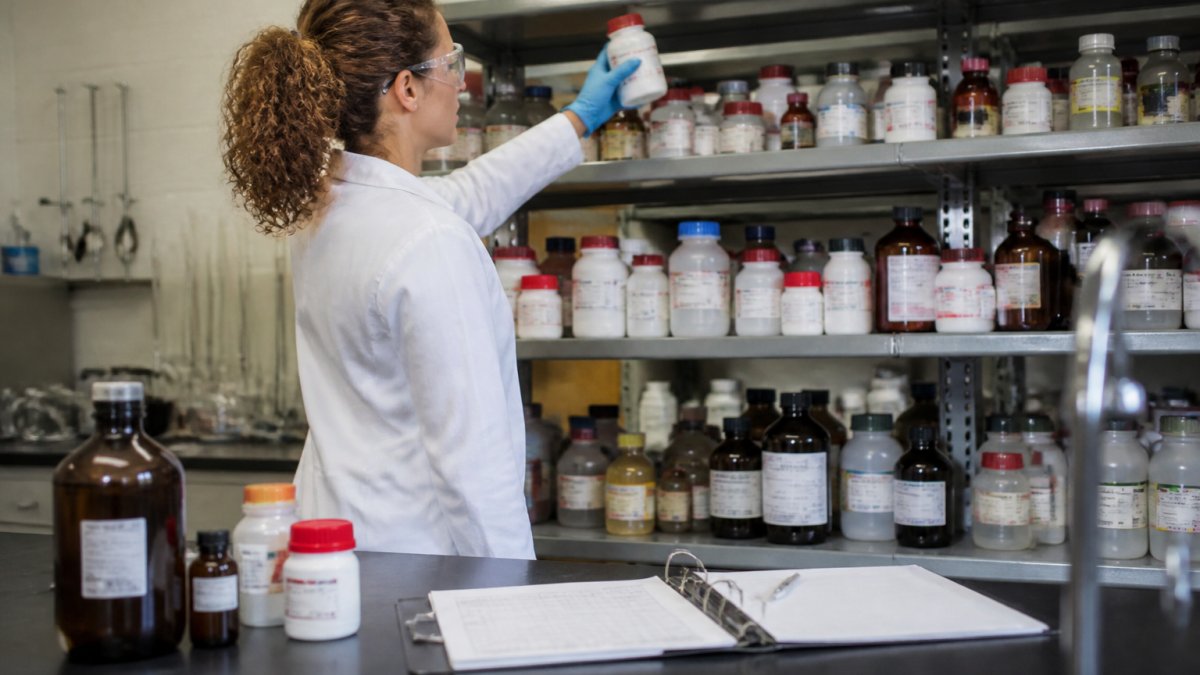
Effective inventory management prevents several common problems: expired chemicals that lose potency, duplicate purchases that waste budget, and storage violations that create safety hazards. Many academic labs use spreadsheet-based tracking, though larger institutions often employ laboratory information management systems (LIMS) that integrate with purchasing and safety protocols.
When setting up your inventory system, track these essential data points:
- Chemical name and CAS number (Chemical Abstracts Service identifier)
- Supplier and batch number
- Purchase date and expiration date
- Current location and quantity
- Hazard classification and SDS reference
- Responsible researcher and approval authority
Start your inventory with chemicals already in your lab, then maintain it as new materials arrive. This baseline prevents gaps in documentation and helps your institution understand what materials you’re actually using. Many compliance audits fail because labs cannot account for chemicals that are supposed to be on hand.
Academic Laboratory Safety Checklist
Before procuring research chemicals, your lab should complete a safety assessment. This checklist helps ensure your facility has the infrastructure and protocols to handle the materials you plan to use.
- Secondary containment available for all liquid chemicals
- Appropriate fume hood or ventilation system for volatile compounds
- Personal protective equipment (PPE) inventory matches chemical hazards
- Eyewash station and safety shower within 10 seconds of work area
- Fire extinguisher appropriate for chemical fires (typically Class D for metals, Class B for organic compounds)
- Spill kit with absorbent materials matching your chemical categories
- Waste disposal containers labeled and segregated by chemical compatibility
- Emergency contact information and incident reporting procedures documented
- All personnel trained on SDS review and emergency response
- Chemical storage organized by compatibility (acids separate from bases, oxidizers isolated)
This checklist is not comprehensive for every possible research chemical, but it covers the foundational safety requirements that apply across most academic chemistry labs. Your institution’s environmental health and safety office can provide more detailed requirements based on your specific research scope.
Compliance and Institutional Requirements
Academic institutions impose compliance requirements that go beyond general chemical safety regulations. Your university likely has purchasing approval workflows, chemical inventory tracking systems, and research ethics review processes that affect how you source materials. Understanding your institution’s requirements before you start shopping prevents delays and ensures your procurement is defensible in audits.
Most universities require:
- Principal investigator approval for all chemical purchases
- Institutional biosafety committee (IBC) or chemical safety committee review for certain compounds
- Documentation that the research protocol has appropriate institutional review
- Verification that the supplier meets institutional vendor standards
- Compliance with state and local regulations specific to your research location
The institutional procurement workflow, step by step
A practical academic purchase usually moves through five stages. Knowing them in advance is the difference between a two-week order and a two-month one.
- Confirm the vendor is approved. Many institutions maintain a list of approved chemical suppliers, and purchasing will not issue a PO to an unapproved vendor. If your preferred supplier is not on the list, ask your procurement office what onboarding requires, often a W-9, a certificate of insurance, and agreement to the institution’s terms.
- Secure purchasing authorization. This is typically a principal investigator or lab manager approval, sometimes routed through a department business office. Know your chart of accounts and the dollar threshold above which additional sign-off is required.
- Attach the required documentation. Purchasing and environmental health and safety (EHS) commonly want the SDS, the CoA or a commitment to provide one, the quantity, the storage location, and the intended use. Some institutions require a hazardous materials receipt form before the package can be delivered to the lab.
- Route any special review. Compounds with dual-use potential, controlled substances, or select agents may require review by a chemical safety committee, IBC, or research compliance office before the order is placed. Build this lead time into your project schedule.
- Receive, log, and reconcile. On delivery, verify the batch against the CoA, log the material into the inventory system, and reconcile the receipt against the PO. This closes the audit trail.
Documentation to keep on file
A defensible academic procurement file generally contains the approved requisition or PO, the vendor’s CoA for the specific batch, the SDS, the inventory entry, and any committee approval. Keep these together, during an audit, the question is rarely whether you had the documents, but whether you can produce them for the specific container on the shelf.
Ask your EHS office for the institution’s chemical hygiene plan and any restricted-substance list before you draft your order. Reviewing those documents first prevents most procurement rejections.
Where institutional rules and supplier practices meet
Institutional vendor standards often go beyond price and documentation. Many universities require suppliers to provide batch-specific CoAs on request, to ship with appropriate hazard labeling and packaging, and to support returns or replacements for non-conforming material. When you evaluate a supplier, ask whether they can meet those terms in writing, a supplier who cannot support your institution’s documentation requirements will create friction at receiving and audit time.
Requesting how to ensure regulatory compliance in research labs provides a detailed framework for navigating these institutional requirements and coordinating with your compliance office.
Starting Your Research Chemical Procurement
When you’re ready to purchase research chemicals academic projects, begin by documenting your project requirements. Write down the specific compounds you need, the purity grade required, the quantity for your experimental timeline, and any special handling or storage needs. This clarity prevents ordering errors and helps you evaluate supplier quotes accurately.
Next, verify that your chosen compounds are appropriate for your research scope and that your institution permits their use. Some universities restrict access to certain chemicals or require additional approval for compounds with dual-use potential. Confirming this before you contact suppliers saves time and prevents wasted procurement effort.
Finally, evaluate suppliers based on documentation quality, compliance transparency, and pricing. Requesting how to buy specialized chemicals for research: a 2026 guide provides step-by-step guidance on the procurement process, from initial vendor evaluation through receiving and verification.
Viva Longevity LLC specializes in supporting academic researchers who need reliable access to specialized materials with full compliance documentation. We provide detailed certificates of analysis, batch-specific safety information, and transparent sourcing practices designed to meet institutional standards. Our 30% discount on all orders helps academic labs stretch limited budgets while maintaining the material quality your research requires. Login to explore our curated selection of research chemicals specifically sourced for qualified academic projects.
Frequently Asked Questions
What are research chemicals used for in academic projects?
Research chemicals serve multiple purposes in academic laboratory work. Screening compounds help test biological hypotheses and validate experimental protocols. Tool molecules enable researchers to investigate specific cellular pathways or molecular mechanisms. Molecular building blocks support synthetic chemistry projects and lead-compound generation. Medical research applications use specialized chemicals for drug-discovery work, while educational activities employ research-grade chemicals to teach laboratory techniques and chemical properties to students and trainees.
What should a chemical certificate of analysis include?
A complete certificate of analysis documents purity levels, typically expressed as a percentage or degree of purity. It lists the specific testing methods used to verify composition, identifies any detected impurities with their concentrations, and includes the batch or lot number for traceability. The document should contain the date of analysis, the laboratory that performed testing, and relevant specifications such as moisture content or particle size. This documentation provides the audit trail and verification your institution requires before approving materials for research use.
How do I verify that a research chemical meets my institution’s compliance requirements?
Start by confirming your institution’s procurement policies with your laboratory manager or compliance officer. Review whether your specific research type requires federal, state, or local authorization. Request that suppliers provide documentation of their compliance procedures, including how they verify qualified buyer status and maintain audit trails. Reputable suppliers like Viva Longevity LLC adhere strictly to federal, state, and local compliance requirements and can provide the verification documentation your legal team needs before approval.
What documentation should I keep for chemical inventory and use tracking?
Maintain records that include the chemical name, supplier, lot number, purchase date, storage location, and quantity received. Document the date each container is opened, who used it, the quantity consumed, and the research project it supported. Track expiration dates and removal dates for depleted or expired materials. This inventory system creates the chain of custody your institution requires and helps you quickly locate materials, manage stock levels, and ensure compliance during audits or regulatory reviews.
Selecting the right research chemicals requires balancing scientific rigor with institutional compliance and safety protocols. Your supplier should be a partner in this process, providing transparent documentation and supporting your compliance obligations. Viva Longevity LLC’s commitment to regulatory adherence and detailed material documentation makes us a trusted resource for academic researchers advancing their scientific work with confidence.

