
Research Chemicals for Pharmaceutical Development
Table of Contents
- What Are Research Chemicals in Pharmaceutical Development
- Types of Chemical Reagents and Compounds Used in Drug Discovery
- The Role of Research Chemicals in Lead Compound Development
- High-Purity Chemical Reagents for Drug Discovery
- Regulatory Compliance for Research Chemical Procurement
- Safety Protocols for Handling Research Chemicals
- Chemical Process Development and Bench-Scale Synthesis
- Selecting a Reliable Research Chemical Supplier
- Frequently Asked Questions
Last Updated: September 19, 2026
What Are Research Chemicals in Pharmaceutical Development
Research chemicals are specialized compounds used by scientists and pharmaceutical companies to discover, develop, and test new drugs. In the context of pharmaceutical development, research chemicals for pharmaceutical development enable researchers to explore drug mechanisms, test efficacy, and establish safety profiles before human trials begin.
Research chemicals are essential across drug discovery stages, from lead compound identification through preclinical testing and process development. Researchers rely on high-purity compounds to ensure accurate, reproducible results while maintaining strict adherence to federal and state regulations.
Types of Chemical Reagents and Compounds Used in Drug Discovery
Small Molecule Inhibitors and Active Pharmaceutical Ingredients
Small molecule inhibitors are research chemicals for pharmaceutical development designed to interact with specific protein targets. Containing fewer than 30 atoms, they cross cell membranes, making them ideal for oral medications.
Active pharmaceutical ingredients (APIs) are the biologically active components of finished drugs. Chemists synthesize and evaluate potential APIs to identify candidates with the right balance of efficacy and safety. Bench-scale synthesis allows researchers to produce small quantities for initial testing before scaling up.
Bioactive compounds demonstrate biological activity in laboratory assays and animal models. Researchers screen compound libraries to identify lead compounds with therapeutic potential, requiring precise synthesis to ensure consistent quality.
Analytical Reference Standards and Bioactive Compounds
Analytical reference standards are pure, well-characterized compounds used to calibrate instruments and validate test methods, ensuring accurate, comparable results across laboratories. Pharmaceutical companies use them to verify purity and identity of research materials and final products.
Bioactive compounds serve as benchmarks for assay development, establishing baseline responses for drug efficacy or toxicity tests. Chemical purity is non-negotiable; even trace impurities can skew results and lead to incorrect conclusions.
| Compound Type | Primary Use | Quality Requirement | Testing Phase |
|---|---|---|---|
| Small Molecule Inhibitors | Target-specific drug candidates | High-purity, structural confirmation | Lead optimization |
| Active Pharmaceutical Ingredients | Finished drug components | Pharmaceutical-grade purity | Preclinical & clinical |
| Analytical Reference Standards | Instrument calibration & validation | Certified purity with documentation | Quality assurance |
| Bioactive Compounds | Efficacy screening & assay development | Research-grade with activity confirmation | Drug discovery |
The Role of Research Chemicals in Lead Compound Development
Lead compound development identifies and refines the most promising candidates from initial screening. Research chemicals for pharmaceutical development provide raw materials for chemical manipulation and testing of molecules showing desired biological activity.
Lead compound development involves iterative cycles of synthesis, testing, and refinement. Chemists modify molecular structure to enhance potency, reduce toxicity, or improve drug absorption. Structure-activity relationship (SAR) studies demand access to diverse chemical reagents and specialty compounds.
Preclinical development involves extensive testing in cell cultures and animal models to gather safety and efficacy data. Research chemicals must be pure and well-characterized; contaminated or impure compounds produce misleading results and delay development timelines.
High-Purity Chemical Reagents for Drug Discovery
Quality Control and Purity Standards
High-purity chemical reagents are non-negotiable in pharmaceutical research. Even small impurities can interfere with assays or produce false results. Researchers typically require 95%+ purity, with many applications demanding 99%+.
Quality control uses HPLC and mass spectrometry to verify purity and identify contaminants, creating an audit trail for regulatory compliance.
Analytical Validation and Assay Development
Assay development relies on analytical reference standards and high-purity compounds. Tests must be validated using known standards to confirm consistent, accurate results before application to unknown compounds.
Analytical validation requires multiple rounds of testing to establish acceptable ranges for controls, determine sensitivity and specificity, and document the process before screening new compounds.
Maintain detailed records of all analytical validation work. Regulatory agencies expect to see comprehensive documentation of assay development, including the purity certificates of reference standards used, the raw data from validation experiments, and the statistical analysis supporting your conclusions.
Regulatory Compliance for Research Chemical Procurement
Federal Regulatory Framework
Pharmaceutical research chemical procurement operates within federal regulatory structure. The FDA establishes Good Laboratory Practice (GLP) standards under 21 CFR Part 58 for nonclinical safety studies supporting IND or NDA applications. Compliance requires certificates of analysis documenting purity, identity, and stability data.
The DEA regulates precursor chemicals and controlled compounds. Researchers working with DEA List I or List II chemicals must obtain appropriate registration and maintain detailed purchase and usage records.
Institutional and State-Level Compliance
Institutional Review Boards (IRBs) and Institutional Biosafety Committees (IBCs) review research protocols and may impose additional documentation or safety requirements. State regulations often exceed federal standards.
Documentation and Chain of Custody
Chain of custody documentation creates an audit trail including purchase orders, certificates of analysis, storage logs, and usage records. Regulatory agencies examine these records to verify materials met specifications throughout the study.
Maintain a centralized chemical inventory database that tracks lot numbers, purchase dates, expiration dates, and storage locations. When regulatory questions arise, this documentation demonstrates that you followed proper procurement and storage procedures. Include photographs of storage areas and equipment maintenance records to show that conditions remained within specification throughout the study period.
Compliance Differences Across Research Stages
Compliance requirements vary by development stage. Early-stage academic research requires institutional chemical safety compliance; clinical-stage research requires FDA GLP compliance, certified suppliers, and comprehensive record-keeping. Experienced suppliers understand these distinctions.
Safety Protocols for Handling Research Chemicals
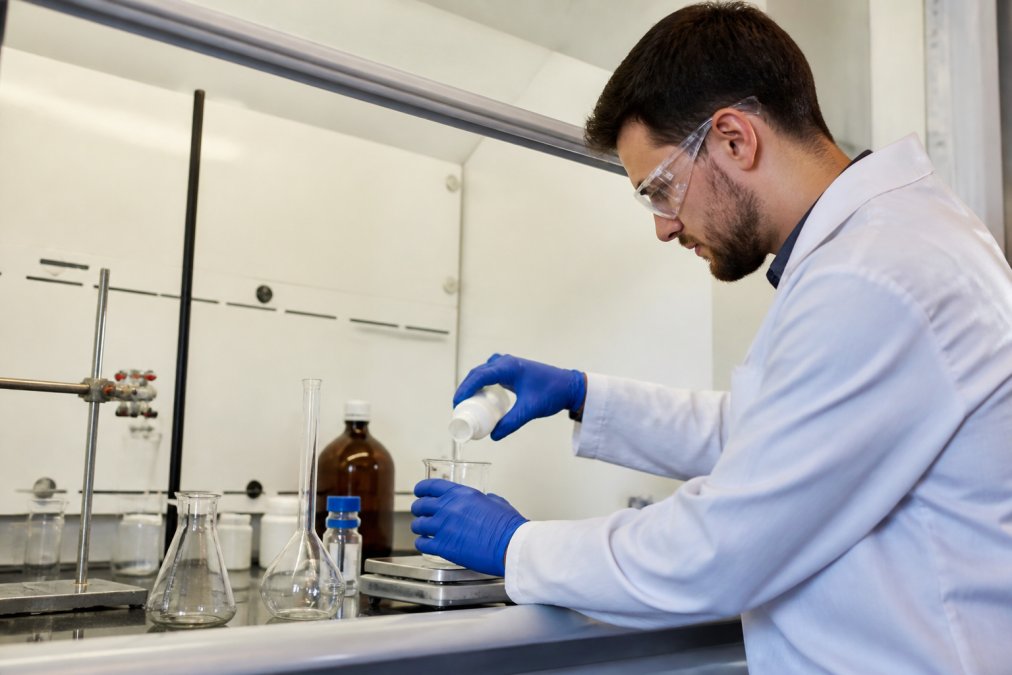
Never combine incompatible chemicals during storage or disposal. Mixing oxidizers with reducing agents or acids with bases can trigger dangerous reactions. When in doubt about compatibility, consult the SDS or contact your chemical supplier for guidance.
Chemical Process Development and Bench-Scale Synthesis
Bench-Scale Synthesis and Route Optimization
Bench-scale synthesis (milligrams to tens of grams) establishes feasible synthetic routes and gathers preliminary data on reaction conditions, yield, and selectivity. Researchers systematically vary parameters, temperature, pressure, solvent, catalyst, stoichiometry, and time, to maximize yield and purity while minimizing waste.
Scale-Up Challenges and Process Intensification
Scale-up introduces heat transfer challenges. Reactions that exotherm rapidly in small flasks become difficult to control in large reactors. Calorimetry studies measure heat release rates; cooling systems must safely remove that heat at manufacturing scale.
Cost and Environmental Optimization
Process development balances yield, cost, and waste. Yield directly impacts cost; atom economy, the fraction of starting material atoms in final product, influences waste disposal expenses. Improving atom economy often requires redesigning the synthetic route.
Process development is not simply “making more of what worked at bench scale.” Scale-up introduces heat transfer, mass transfer, and economic constraints that require fundamental changes to synthetic routes. Successful process development teams include process chemists, chemical engineers, and analytical chemists working collaboratively to optimize yield, purity, cost, safety, and environmental impact simultaneously.
Analytical Method Development for Process Control
As processes scale, analytical methods must evolve to support manufacturing. Bench-scale work relies on laboratory HPLC and NMR, which provide high accuracy but require 30 minutes to several hours per analysis. Manufacturing requires faster feedback; process analytical technology (PAT) enables real-time monitoring of reaction progress. Near-infrared (NIR) spectroscopy, Raman spectroscopy, and in-situ FTIR can monitor reaction completion without sampling, allowing operators to stop the reaction at optimal conversion rather than running to a predetermined time.
Selecting a Reliable Research Chemical Supplier
Choosing a supplier for research chemicals for pharmaceutical development requires careful evaluation. Reliability directly impacts your research timeline and data quality. A trustworthy supplier consistently delivers high-purity materials with complete documentation, maintains regulatory compliance, and responds promptly to customer needs.
Frequently Asked Questions
What documentation is required for legal procurement of research chemicals?
Legal procurement requires proof of institutional affiliation, a statement of intended use, and compliance documentation confirming the research chemicals will be used only for legitimate research or educational purposes. Most suppliers require institutional verification, purchase orders, and may request chain-of-custody records. Federal regulations mandate that suppliers maintain records of all transactions for auditing purposes. Your institution’s compliance office can provide specific documentation templates required by your state and institution type.
How do I verify that research chemicals are truly high-purity and not repackaged materials?
Reputable suppliers provide certificates of analysis (CoA) and third-party analytical validation for each batch. High-purity chemical reagents for drug discovery should include purity percentages, impurity profiles, and testing methodologies. Request documentation showing the supplier’s quality assurance processes, batch testing records, and whether they conduct independent verification. Ask about their supply chain transparency and whether they maintain audit trails from synthesis through delivery. Viva Longevity LLC provides detailed purity reports and compliance documentation for all products.
What is the difference between analytical grade and research grade chemicals?
Analytical grade chemicals meet strict purity standards (typically 99%+) and are suitable for precise assays and reference standards. Research grade chemicals are high-purity but may have slightly broader acceptable impurity ranges, making them appropriate for synthesis, screening, and process research and development. The choice depends on your specific application: use analytical grade for quantitative assays and quality control; research grade for exploratory work and bench-scale synthesis. Your research protocol and regulatory requirements will determine which grade is necessary.
How do I ensure safety protocols for handling research chemicals in my lab?
Safety protocols for handling research chemicals require proper training, personal protective equipment (PPE), and engineered controls. Always use fume hoods for volatile compounds, maintain Material Safety Data Sheet (MSDS) documentation, and follow your institution’s chemical hygiene plan. Store chemicals according to compatibility guidelines, maintain proper labeling, and ensure emergency response procedures are in place. Your facility should conduct regular safety audits and provide staff training on hazard recognition. Consult OSHA guidelines and your institutional safety officer for lab-specific requirements.
What makes a research chemical supplier trustworthy for pharmaceutical development work?
A trustworthy supplier maintains transparent supply chain documentation, provides third-party verification of purity, and demonstrates regulatory compliance with federal and state requirements. Look for suppliers with established audit trails, institutional partnerships, and clear policies on product sourcing and quality assurance. They should offer detailed certificates of analysis, respond to compliance questions from your institution’s legal team, and provide consistent batch-to-batch quality. Viva Longevity LLC distinguishes itself through strict adherence to federal, state, and local compliance standards and a professional approach to regulatory documentation.
